How to Choose a Pop Up Canopy for Brand Events
Sizes, frames, fabrics, printing and the details most buyers only notice on the second order. A practical guide from our factory floor for brand managers, agencies and distributors buying their first — or fifth — custom canopy.
Updated 16 October 2026 · Reading time about 8 minutes · By the Dtent product team
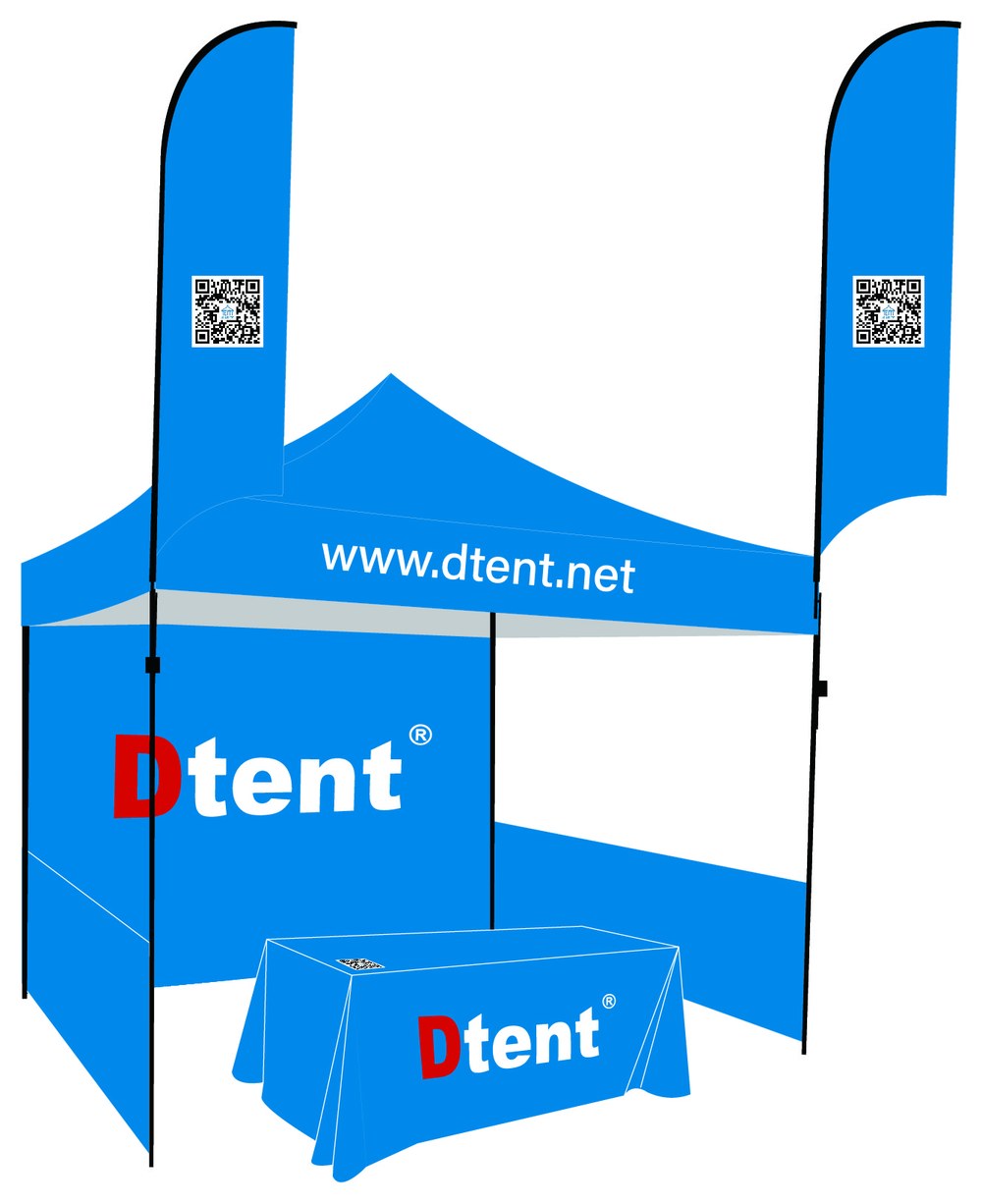
Start with the job, not the size
The most expensive mistake in this category is ordering a size before you know what has to happen underneath it. A canopy is not a photo studio — it is a working space that has to hold people, furniture and product while still looking sharp from ten metres away.
Write down four numbers first: how many staff will be working, how many tables or counters you need, whether a queue will form, and how much display product must stay out of the rain. Then, and only then, choose a footprint.
Two canopies with identical dimensions can feel completely different inside. Leg position, roof geometry, whether the walls are open or closed, and where the doorway sits all change how much room your team actually gets.
Decision 1 — Size: match the footprint to the activity
These are the sizes we build most often for brand and event work. Square footage is the raw footprint; usable space is always a little smaller once legs, tables and sidewalls take their share.
| Size | Footprint | Typical use |
|---|---|---|
| 8 x 8 ft (2.4 x 2.4 m) | 64 sq ft | Single-staff sampling station, compact mall activation |
| 10 x 10 ft (3 x 3 m) | 100 sq ft | Standard trade show booth, market stall, sports team |
| 10 x 15 ft (3 x 4.5 m) | 150 sq ft | Counter plus demo space, food and beverage vendor |
| 10 x 20 ft (3 x 6 m) | 200 sq ft | Product launch, car display, multi-staff activation |
| 13 x 13 ft (4 x 4 m) | 169 sq ft | Hospitality areas, VIP zones, larger festivals |
Areas are nominal footprints. Add 1–2 ft of clearance on every side for guy ropes, ballast and visitor circulation.
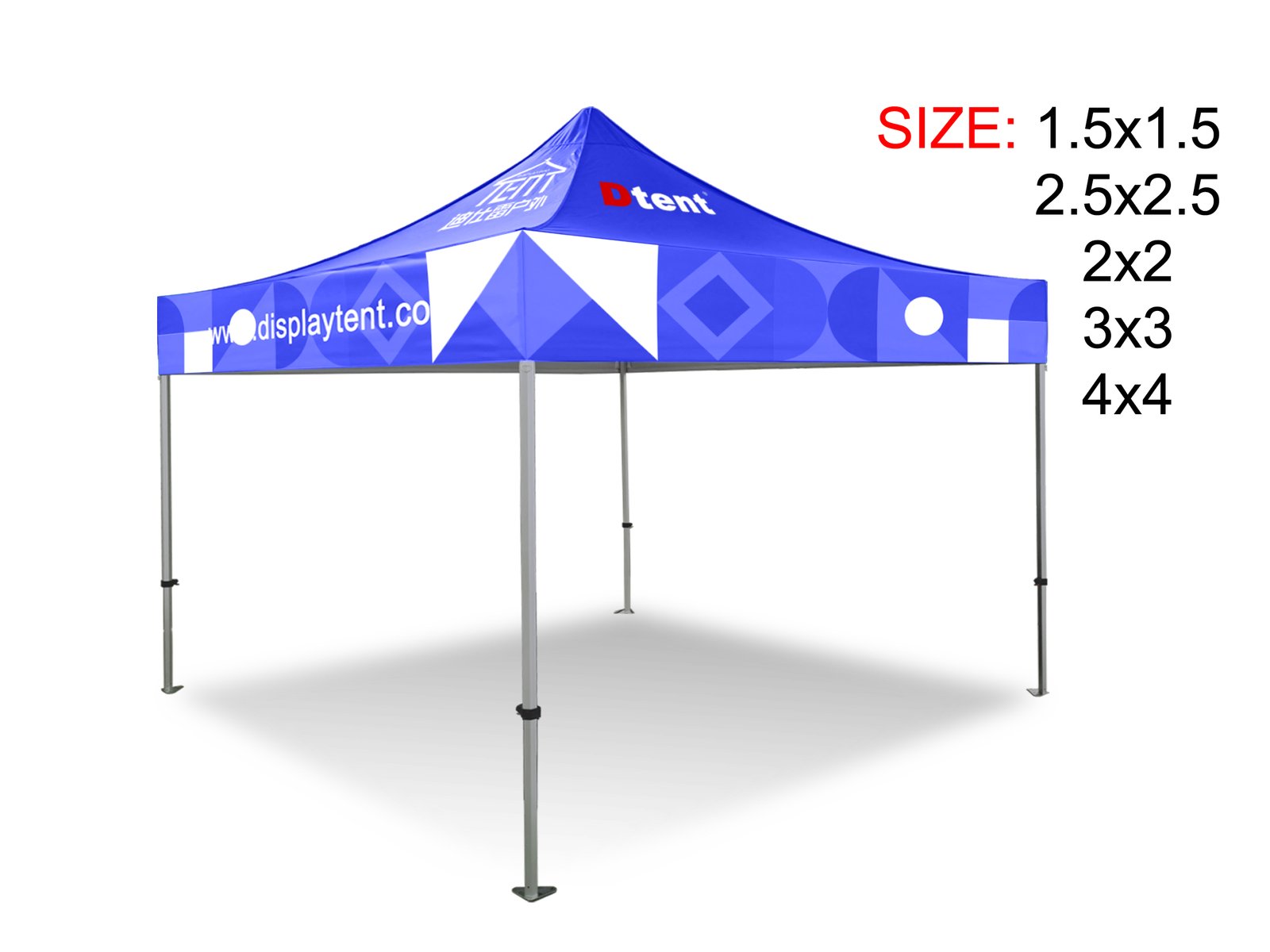
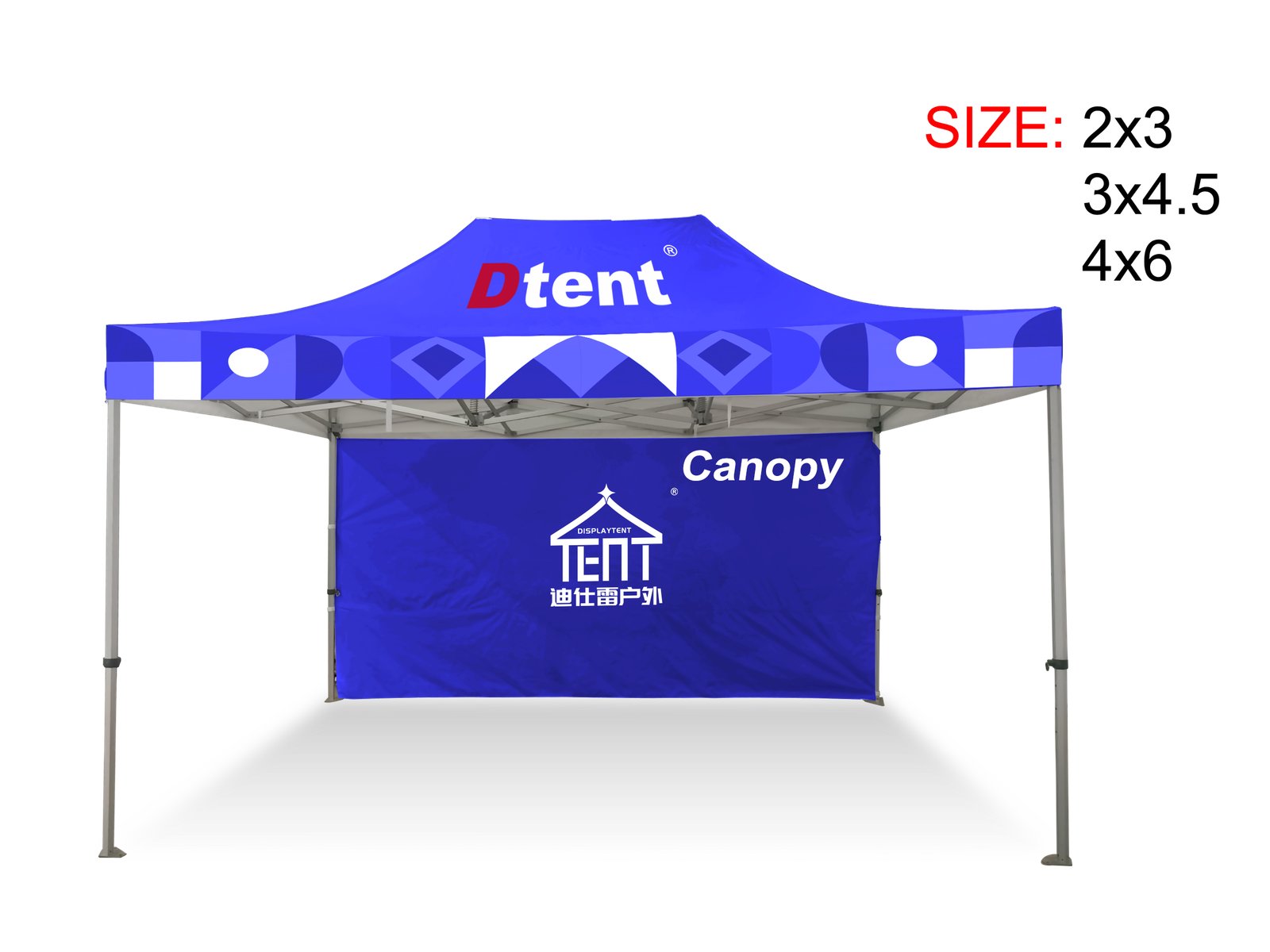
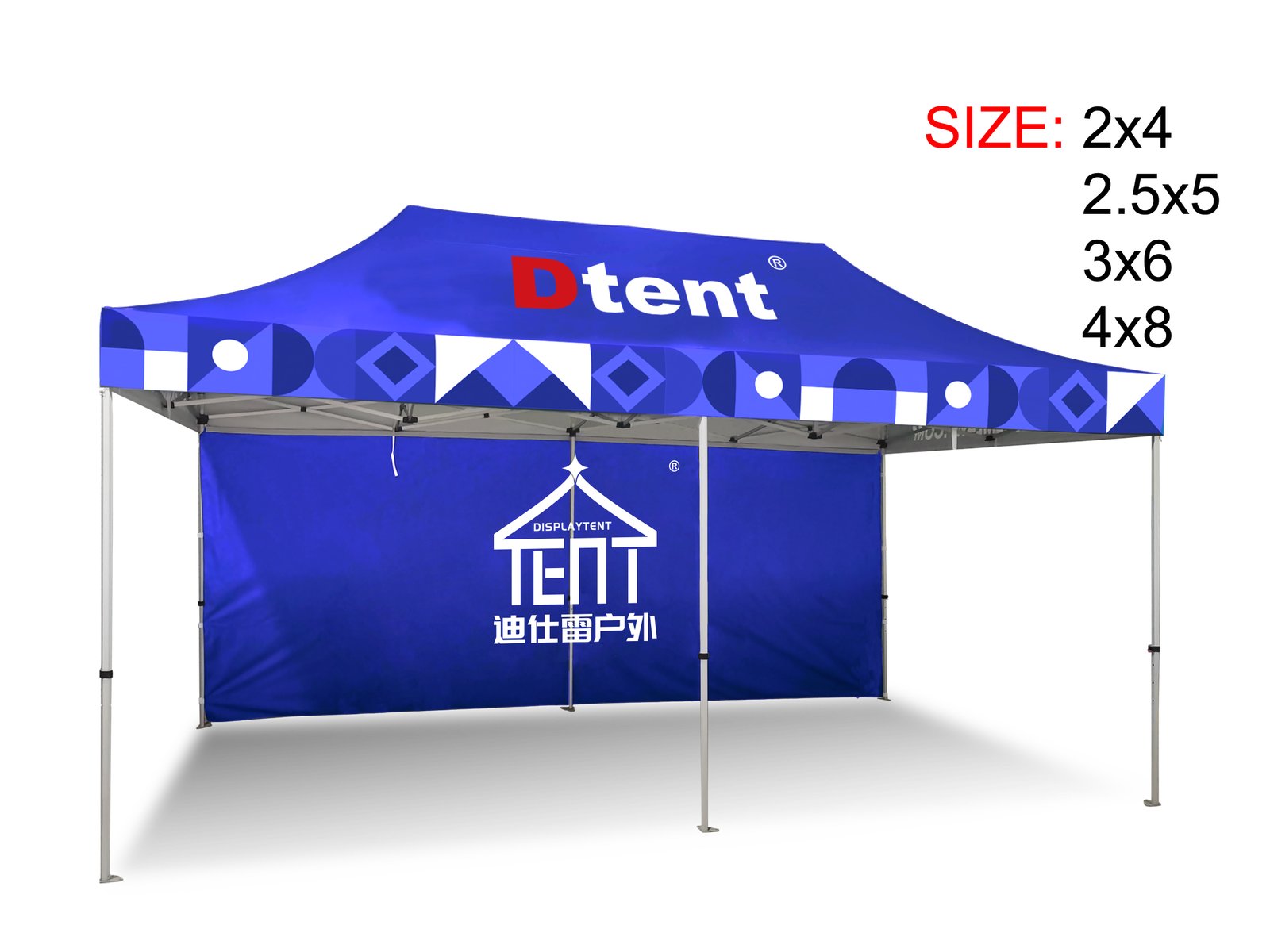
Bigger is not automatically better. A larger roof catches more wind, weighs more, needs another pair of hands at setup and costs more to ship. A well-engineered 10 x 10 will usually outperform a cheaply built 10 x 20 on every measure that matters to your brand — how straight the frame stands, how crisp the print looks and how long it survives a season of events.
Decision 2 — Frame: wall thickness beats good looks
Frames are sold on outer leg diameter, but diameter alone tells you very little. Two 32 mm legs can carry very different loads depending on wall thickness, alloy and how the joints are made. Ask for the actual numbers, not a "heavy duty" label.
- Steel — the value option and perfectly serviceable for a handful of events a year. Heavier to carry, and the powder coating has to stay intact or rust starts at the scratches.
- Aluminium — around a third of the weight and naturally corrosion-resistant. The default choice for agencies, rental fleets and brands that set up every weekend.
- Wall thickness — the single best predictor of how the frame behaves in wind. Thin walls flex; flexing frames crack at the joints.
- Fittings — glass-filled nylon or ABS hubs and truss bars absorb shock far better than brittle plastic, and they are what fails first on bargain canopies.
- Leg profile — hexagonal legs are stiffer in the direction that matters, which is why most commercial folding frames use them.
- Height adjustment — look for a thumb-latch or pin system with several positions so the canopy can be levelled on uneven ground.
A quick test when you receive a sample: open and close the frame ten times. A good frame moves smoothly with no grinding, every leg latches at the same height, and nothing rattles when you shake it. That minute of handling tells you more about joint quality than any specification sheet.
Decision 3 — Fabric: denier, coating and what "waterproof" really means
Canopy tops are almost always woven polyester measured in denier (D) — the weight of the yarn. 420D to 500D is light and economical; 600D is the commercial standard because it holds full-colour print, resists abrasion and keeps its shape after repeated folding.
Denier is only half the story. The reverse of the fabric carries a PU or PVC coating that provides water resistance and blocks UV, and the coating is what ages first under sun and rain. Two fabrics with the same denier but different coatings will perform very differently after twelve months outdoors.
And here is the part most buyers learn the hard way: a waterproof fabric does not guarantee a waterproof canopy. Water gets in through the seams, the stitch holes and the join between roof and valance. If you expect heavy rain, ask how the seams are sealed and specify a canopy with taped or welded seams rather than relying on the fabric alone.
For any indoor or public event, also confirm fire-retardant treatment and ask for the test certificate your venue will request.
Decision 4 — Printing: pick the method by design, not by price
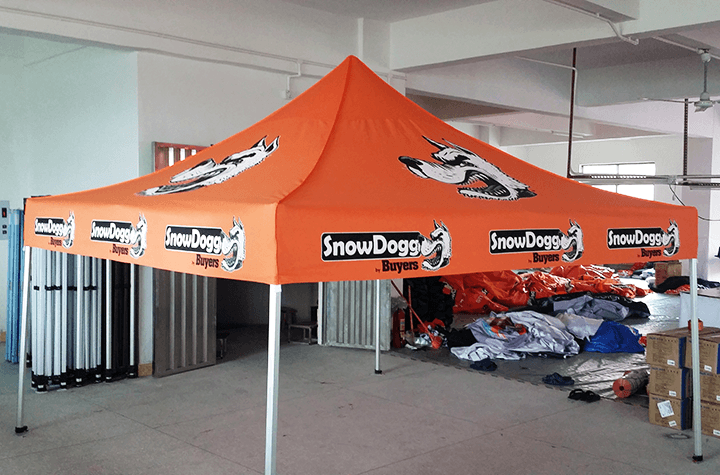
There are three methods used for branded canopies, and they are not interchangeable.
- Dye sublimation — the design is printed into the fabric, so gradients, photographs and full-colour artwork reproduce cleanly and cannot peel or crack. This is what you want for a fully printed canopy roof.
- Screen printing — opaque ink laid on the surface. Cheapest way to print one to three flat spot colours across a large quantity, but it cannot reproduce photos or fine gradients.
- Heat transfer — a printed film applied to the panel. Useful for small runs with fine detail or when you need an exact Pantone match at low volume.
Artwork matters more than most buyers expect. Vector files (AI, PDF, EPS) give the cleanest result. If all you have is a low-resolution logo or a photo of a business card, a good factory will redraw it — ask whether that is included before you place the order.
You do not have to print everything. A logo on the roof and valance, a printed backwall and plain sidewalls will carry your brand convincingly at a lower cost than full coverage. Decide which surfaces a visitor will actually see from the aisle, and print those.
Decision 5 — Accessories and logistics: what buyers forget
The canopy is the beginning of the order, not the whole of it. These are the items that decide whether the booth looks finished and whether the product survives the season.
- Ballast — 20 lb sandbags or 30 lb weights on every leg on hard ground; stakes and guy ropes on grass. Never leave the weights in the office.
- Walls — solid, zipped-door or windowed panels in printed or plain colours. Hook-and-loop attachment is faster than zips at a busy venue.
- Half walls and rail skirts — the most cost-effective way to add a printed message along the front of the booth.
- Roller bag — wheels and a reinforced base pay for themselves the first time you travel alone.
- Rain gutter and junction parts — let you join two canopies into one long stand without water dripping between them.
- Flag holder — mounts a feather flag on the canopy leg so it travels with the booth. Pair it with printed flags to pull traffic from further away.
Then check the freight maths. A larger canopy means longer cartons, which can push you over a pallet dimension and change the shipping cost more than the canopy price difference. Ask for carton dimensions and gross weight per unit before you commit to a size.
The five decisions as a checklist
- Footprint chosen from the activity inside the booth, not from a catalogue page
- Frame material matched to how often you will set it up
- Fabric denier confirmed and seam construction understood
- Printing method matched to your artwork, not to the lowest quotation
- Ballast, walls and transport planned as part of the same order
What actually moves the price
Buyers are often surprised that two quotations for a "10 x 10 printed canopy" can differ by a factor of three. In practice the price is driven by four things: frame material and wall thickness, fabric denier and coating, how much of the canopy is printed, and order quantity. Size comes fifth — a well-specified 10 x 10 frequently costs more than a cheaply made 10 x 20.
When you compare quotations, compare specifications line by line. A quotation that does not state frame material, wall thickness, fabric denier and print coverage is not a lower price — it is an unknown one.
FAQ
What size pop up canopy do I need for a trade show booth?
Most standard exhibition allocations are built around a 10 x 10 ft (3 x 3 m) footprint — about 100 sq ft of ground coverage. Move up to 10 x 15 ft when you need a counter and demonstration space, and 10 x 20 ft for product launches, food service or more than three staff. Confirm the organiser's maximum dimensions before ordering.
Is a steel or aluminium canopy frame better?
Steel is the value choice and fine for occasional events, but heavier and prone to rust if the coating is damaged. Aluminium is roughly a third lighter, resists corrosion and is the standard for weekly use. Either way, wall thickness and joint design matter more than the outer leg diameter.
What fabric is used for a printed pop up canopy?
Commercial canopies are usually 420D to 600D polyester with a PU coating on the reverse for water resistance, plus UV inhibitors. 600D is the most common choice for branded canopies because it holds full-colour print well and resists abrasion during repeated setup.
What is the difference between dye sublimation, screen printing and heat transfer?
Dye sublimation prints into the fabric, so colours, gradients and photos reproduce vividly and cannot peel. Screen printing lays opaque ink on the surface and is cheapest for one to three flat colours in volume. Heat transfer suits small, detailed runs. For a fully branded roof, sublimation is normally the right answer.
How much weight do I need to hold a canopy down?
A canopy is a sail, so weights are not optional. On grass use stakes and guy ropes; on asphalt or indoor floors use 20 lb sandbags or 30 lb weights on every leg. In gusty conditions add ballast and keep at least one wall open so wind can pass through. Never use a canopy outside the manufacturer's specified conditions.
What is the minimum order for custom printed canopies?
Sample orders start from one piece. Most brands order five to ten units to reach a better unit price, and mixed sizes can be combined in one shipment. Custom dimensions, Pantone colour matching and OEM packaging are all available.
Next step
If you already know your size, send us your logo and quantity and we will come back with pricing, a print mock-up and carton weights. If you are still deciding, tell us what the booth has to do and we will recommend a configuration — that conversation is free and usually saves more than any discount.