10 x 10 vs 10 x 15 Canopy: Which Size Do You Need?
On paper the difference is 50 square feet. In the real world it decides whether you can run a product demo, fit a second staff member and keep a queue out of the rain — or whether your team spends the day stepping around each other.
Updated 17 October 2026 · Reading time about 7 minutes · By the Dtent product team
The number nobody puts on the quote
Both canopies use the same frame system, the same fabric and the same printing process. The only real question is how much room your team needs to do the job they were sent to do. That is a question about layouts, not about square footage.
We build both sizes every week and we have watched buyers make the same two mistakes in opposite directions: ordering a 10 x 10 because it is cheaper, then discovering there is nowhere to demonstrate the product; or ordering a 10 x 15 for a one-person sampling stand, then paying for air freight they did not need.
This guide removes the guesswork. Below you will find the usable space in each size, six real booth layouts, the cost and weight differences, and a 60-second checklist at the end.
The paper difference vs the real difference
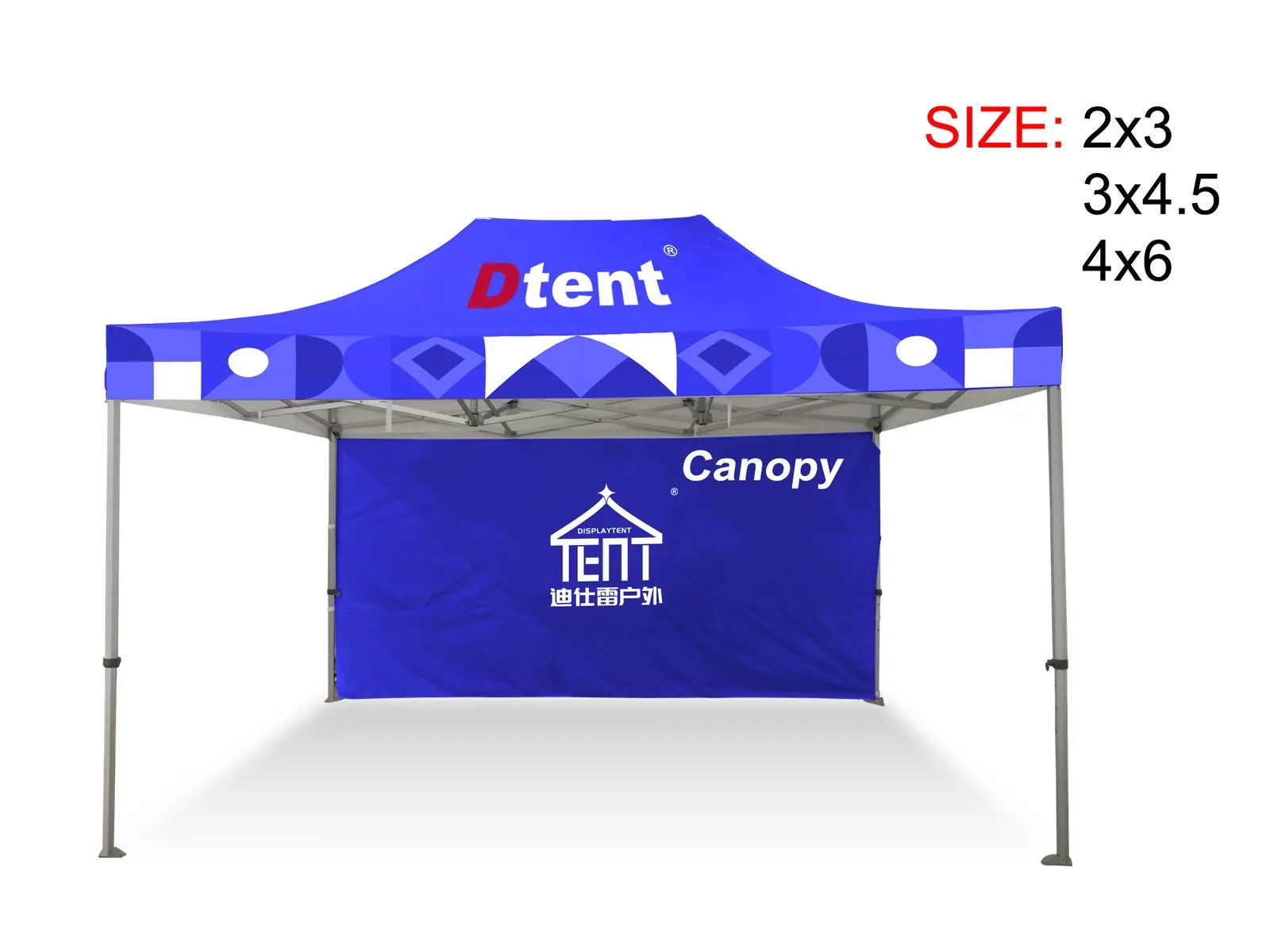
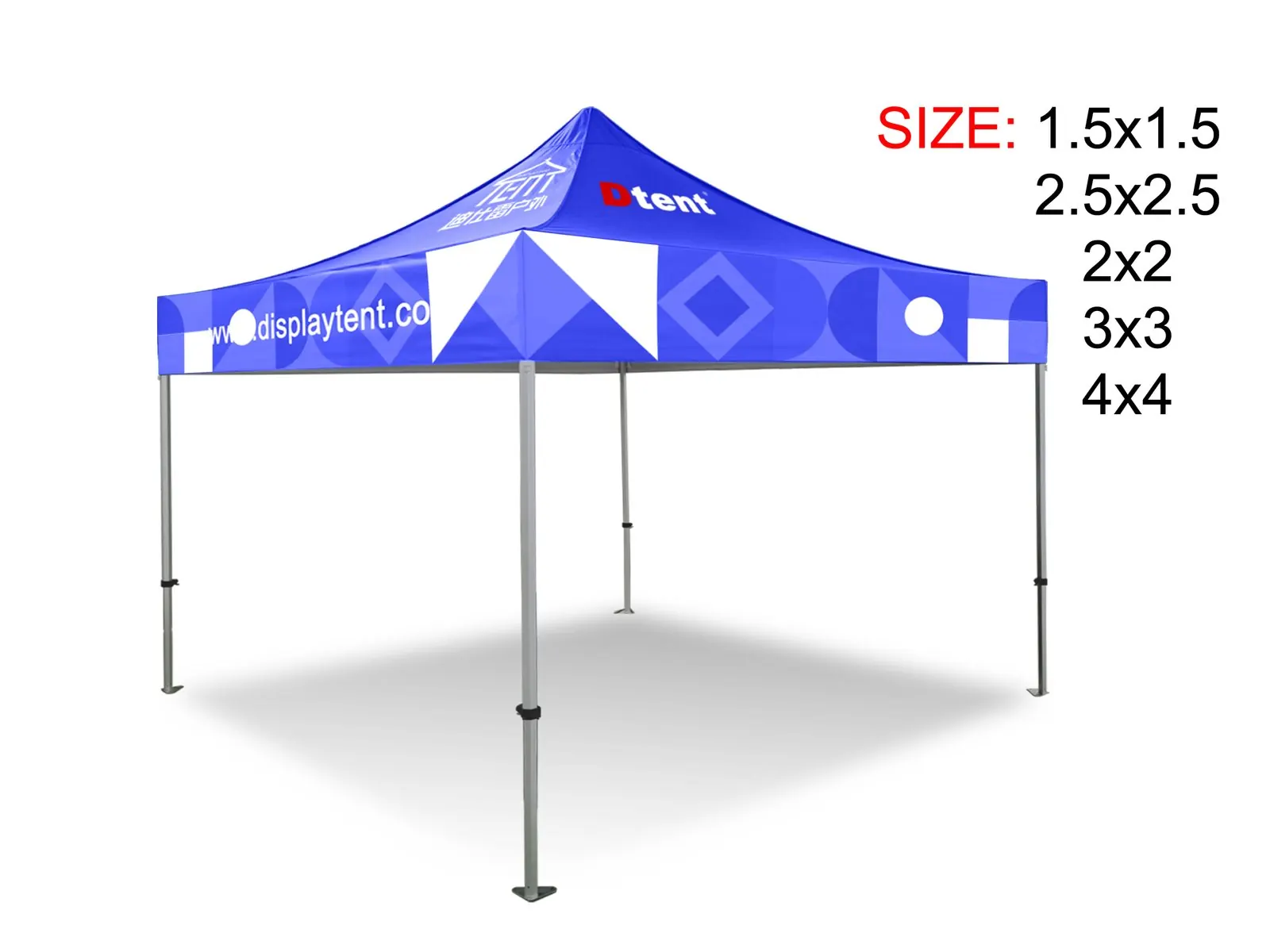
A 10 x 10 ft canopy is 3 x 3 m — 100 sq ft, or about 9 m². A 10 x 15 ft canopy is 3 x 4.5 m — 150 sq ft, or about 13.5 m². That is 50% more floor on paper.
Inside the frame it feels like more than that, because usable space is a shape, not a number. Take a typical 6 ft (1.8 m) trestle table:
- In a 10 x 10: the table sits across one side and leaves roughly 1 m of standing room behind it. One person can work there comfortably. A second person has to stand beside the table, outside the roof line.
- In a 10 x 15: the same table leaves about 2.6 m of depth. Now you have a working counter at the front, a demonstration or meeting area behind, and space to store stock cases against the back wall.
The extra 1.5 m of depth is what actually sells the 10 x 15. It is one continuous strip of usable floor, not a slightly larger square that still fills up with furniture.
Footprints are measured between the leg centres. Add 0.3–0.5 m of roof overhang on each side and 1 m of clearance for guy ropes and visitor circulation.
What actually fits — six layouts, side by side
This is the table we use when a buyer sends us a booth plan. Find the layout closest to your event and read across.
| Booth layout | 10 x 10 ft | 10 x 15 ft |
|---|---|---|
| One staff member with a leaflet counter | Comfortable | Wasteful — money spent on empty floor |
| One staff member, table plus stock cases | Workable | Comfortable |
| Reception counter plus product demo area | Not workable | Comfortable |
| Two staff, product on two facing walls | Tight — no storage | Comfortable |
| Sample table plus small meeting table and two chairs | Not workable | Tight but workable |
| Food or beverage service with a queue | Not workable | Comfortable |
| Car, large machinery, full booth build-out | No | No — step up to 10 x 20 |
Two rows in that table are the ones that catch buyers out. "Two staff with product on two facing walls" sounds like a 10 x 10 job, but with no closed wall you have nowhere to hide cartons, and the booth looks untidy by the afternoon of day one. And "sample table plus meeting table" is the layout every distributor asks for and every 10 x 10 fails at.
Rule 1 — The organiser's floor plan beats every other argument
Most exhibition halls sell space in standard units. A single unit is usually 3 x 3 m, and the walls, aisles and fire lanes are fixed. If you have booked one unit, a 10 x 15 canopy will overhang the boundary, block the aisle and, in most venues, fail the safety inspection on setup day.
Check the contract before you choose a size. If the organiser offers a 3 x 4.5 m or 3 x 6 m unit, take it — corner and island stands are worth the premium for a brand that needs demonstration space. If the stand is fixed at 3 x 3 m, a 10 x 10 is not a compromise, it is the only compliant option.
Rule 2 — Count people and tables, not square metres
Two numbers decide the size faster than any calculation:
- How many people work under the roof at the same time? Allow about 0.9 m of working width per person at a counter. Three people at the front of a 3 m canopy is already crowded.
- How many tables or counters are there? One table fits a 10 x 10. Two tables — even a small meeting table — need the depth of a 10 x 15.
If the answer is "one person, one table", a 10 x 10 is the right purchase and a 10 x 15 is a waste of freight. If the answer is "two people and we need to show the product working", stop reading and order the 10 x 15.
Rule 3 — Storage is the hidden requirement
Nobody lists "somewhere to put eight cartons" on a booth plan, but every team needs it. In a 10 x 10 with one table there is no defined back area; cases end up in the visitor's line of sight or under the table where nobody can reach them.
A 10 x 15 with a single printed back wall gives you a clean working area behind the counter — stock, samples, bags and a chair for the person who has been standing for six hours. Add a half wall on one side and you also get wind protection and a place to hang a banner.
Rule 4 — How the canopy travels home
This is the rule buyers forget, and it is the one that turns a good decision into a daily annoyance.
| Specification | 10 x 10 ft (aluminium) | 10 x 15 ft (aluminium) |
|---|---|---|
| Frame + roof weight | About 18–22 kg | About 26–32 kg |
| Packed bag length | About 1.55–1.65 m | About 1.75–1.90 m |
| Packed volume | About 0.16–0.20 cbm | About 0.26–0.33 cbm |
| People needed to erect | 1 experienced, 2 comfortable | 2 minimum, 3 on first setups |
| Typical vehicle | SUV, estate, small van | Van or trailer |
A 1.9 m bag does not fit across a sedan boot, and it does not go on a roof rack without a proper carrier. If your regional reps travel by car, a fleet of 10 x 10 canopies will be used far more often than a 10 x 15 that only comes out for the big show.
Rule 5 — Wind load scales with roof area
A canopy is a sail. Adding 50% of roof area adds roughly 50% of wind load at the same wind speed, and the lever arm on the legs gets longer too. That changes the ballast requirement, not just the price.
- 10 x 10, outdoor, light breeze: a 20 lb weight on every leg is the minimum most organisers accept.
- 10 x 15, outdoor: plan on 30–40 lb per leg, and add guy ropes on the two windward corners.
- Indoors: weights are still required near doors and loading bays where air moves.
If your event programme includes coastal sites, exposed fields or autumn shows in northern Europe, budget for the ballast at the same time as the canopy. It is a small line item that prevents a very expensive incident.
What the price difference really is
The 10 x 15 is not 50% more expensive. Fabric area rises by roughly 45–55% depending on how many walls you order, but the frame hardware, the printing setup and the packaging are shared across the larger roof, so the unit price per square metre usually comes out 8–12% lower.
Where the 10 x 15 costs more than the sticker suggests:
- Freight. Couriers bill volumetric weight, so the packed volume matters more than the actual weight. A 10 x 15 box frequently bills at 1.5–2 times its scale weight on air and express services.
- Labour. Two people for an hour instead of one person for ten minutes, at every single event.
- Storage. A 10 x 15 bag takes a corner of a small warehouse that a 10 x 10 does not.
None of that makes the larger canopy a bad buy. It simply means the right comparison is cost per usable square metre across a season, not the line on the invoice.
The combination most brands settle on
After two or three seasons, most of our repeat customers end up with a mixed fleet rather than one size:
- One or two 10 x 15 units for the important shows — the ones with demonstration space, a meeting table and senior staff on the stand.
- Three to six 10 x 10 units for regional activations, sampling teams, dealer events and anything that travels by car.
- One visual system across both sizes — same Pantone references, same logo position, same wall layout — so a small activation still looks like the same brand as the flagship stand.
This is also the cheapest way to buy, because both sizes share fabric, printing setup and shipping consolidation. Send us one order with both sizes and the printing cost is quoted once.
Decide in 60 seconds
Answer these five questions in order and stop at the first "yes":
- Does the floor plan give you more than 3 x 3 m? → 10 x 15 (or larger).
- Do two or more tables have to fit under the roof? → 10 x 15.
- Does the product need to be demonstrated, tasted or tested by visitors? → 10 x 15.
- Do two or more staff work under the roof at the same time? → 10 x 15.
- Does the canopy have to travel in a car and be set up by one person? → 10 x 10.
If none of those apply, a 10 x 10 is the correct and most economical choice. Buy the size that matches the job, not the size that looks impressive in a photograph.
FAQ
What is the actual size of a 10x10 and a 10x15 canopy?
A 10 x 10 ft canopy measures 3 x 3 m at the frame footprint, covering 100 sq ft (about 9 m²). A 10 x 15 ft canopy measures 3 x 4.5 m, covering 150 sq ft (about 13.5 m²). The roof overhangs the legs by roughly 0.3–0.5 m on each side, so the roof area is larger than the footprint, but the space you can stand in is measured between the legs.
How much more space does a 10x15 give me over a 10x10?
On paper it is 50% more floor area. In practice the gain feels larger because the extra depth is one continuous strip. A 10 x 10 with a 6 ft (1.8 m) table leaves about 1 m of standing room behind it; a 10 x 15 with the same table leaves about 2.6 m — enough for a demonstration zone or a second table.
Can I put a 10x15 canopy on a standard 10x10 exhibition stand?
No. Organisers measure the space you pay for, and a 3 x 4.5 m canopy will overhang a 3 x 3 m stand, blocking the aisle and breaking fire regulations. Rent two adjacent stands or an island space if you need 10 x 15. Angled or inflatable frames do not change this rule.
How many people does it take to set up a 10x15 canopy?
Two people for a 10 x 15 ft push-up frame, with a third helping on the first two or three setups. A 10 x 10 ft frame can be raised by one experienced person in about ten minutes, but two is faster and safer in wind. Build setup time into the event plan, not just the price.
Will a 10x15 canopy fit in a normal car?
Usually not. A 10 x 15 ft canopy packs into a wheeled bag roughly 1.75–1.9 m long and 26–32 kg, which will not fit across a sedan boot. A 10 x 10 ft canopy typically packs around 1.6 m and 18–22 kg and fits in most SUVs with the seats folded. If your team travels by car, this often decides the size for you.
Is a 10x15 canopy cheaper per square metre than a 10x10?
Yes — typically 8–12% cheaper per square metre, because the frame joints, hardware and printing setup are shared across a larger roof. The total price is still higher. Mixing one 10 x 15 with two or three 10 x 10 canopies usually gives the best cost per usable square metre across a season.
Next step
Tell us the floor plan, the number of staff and what the booth has to do, and we will confirm the size in one message — before you commit to a purchase order. Both sizes are printed in-house in Dongguan, with Pantone matching and a free mock-up of the roof layout.