Pop Up A-Frame Banners for Sports Events: Course Marking, Sponsor Boards and Sideline Sales
Race organizers and golf clubs are the single biggest repeat buyers of pop up A-frame banners — and once you see how they use them, the reason is obvious. One banner does a job that normally needs two products: it marks the course like a rigid sign, and it folds into a carry bag like a flag. This guide covers the placement playbook, the sponsor math, wind anchoring and how fifty different sponsor logos fit into one production run.
Updated 6 November 2026 · Reading time about 7 minutes · By the Dtent events team
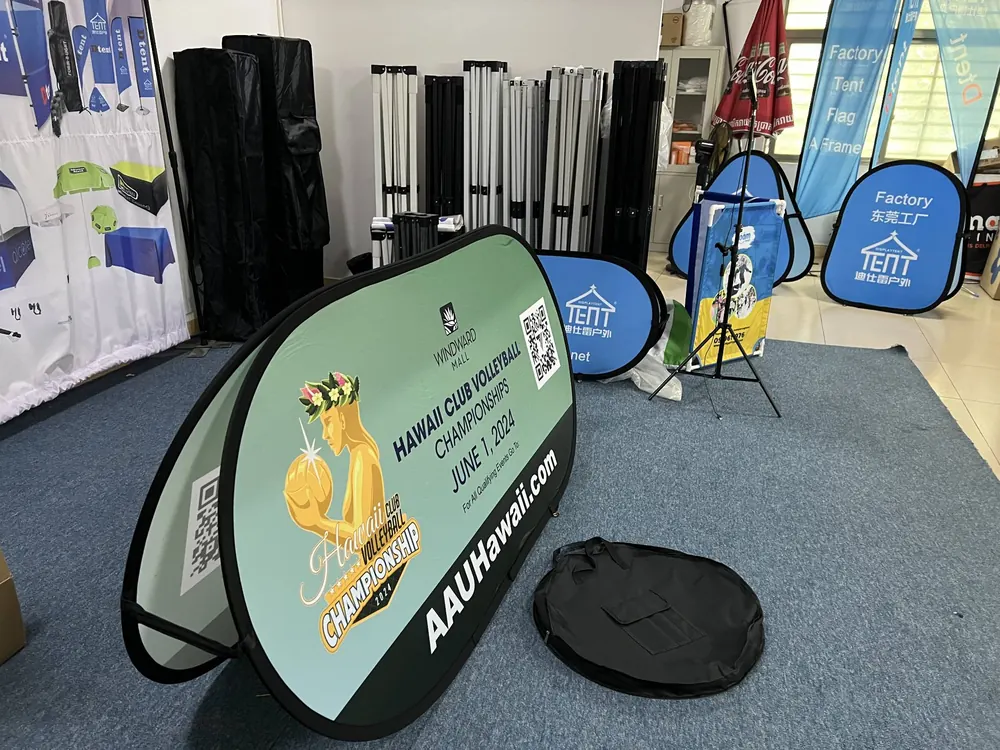
Why fabric A-frames own the sideline
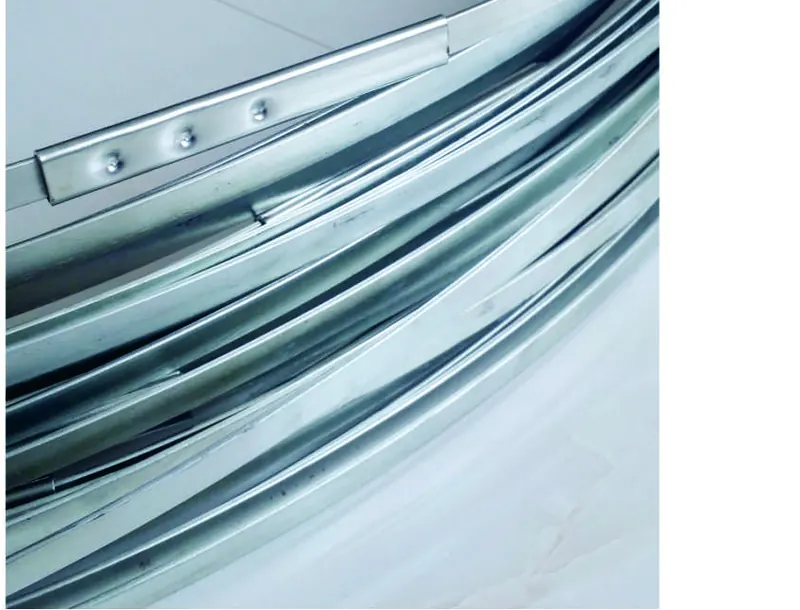
Rigid sign boards were the default course marker for decades, and they are terrible at it. They glare in sunlight. They dent when a trolley clips them. They chip, they splinter, and they need a van and a storage rack. A fabric A-frame fixes every one of those failures: no glare (the print is matte textile), no denting (it pops back to shape), no rust (coated spring steel), and it folds flat into a round bag a volunteer can carry.
The economics close the argument. One A-frame banner survives season after season — wash it, roll it, next event. Our longest-running customers replace their banners when the sponsor changes, not when the banner wears out. That is the right kind of product lifetime for anyone who re-sells course visibility every year.
Where A-frames earn their keep
Across the orders we ship to race organizers, golf clubs and sports marketing agencies, the same six placements come up again and again:
- Start and finish arches. Flanking the finish line with two or four branded A-frames puts the title sponsor into every finish-line photo.
- Course edges. One every 150–300 metres marks the route and sells sponsor visibility at the same time.
- Water and aid stations. The single highest-dwell-time spot on any course — runners stand still for a minute, reading your sponsor's message.
- Golf fairways and tee boxes. Hole sponsorship boards; the oval 100 × 200 cm size is the club favorite.
- Beach volleyball and triathlon. Sand pockets make beach placement trivial — a stake cannot go into soft sand, but a weighted fabric frame stands anywhere.
- Registration and expo floors. Indoors, an empty-frame A-frame guides foot traffic without weights, walls or stands.
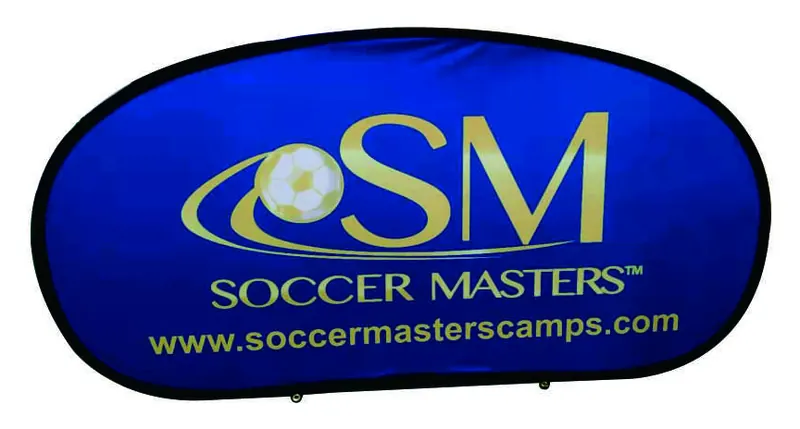
The sponsor math (why your sponsors will pay for these)
A sponsor buying course visibility is buying seconds of attention. Rigid trackside boards buy half a second at speed. A-frames buy more, in two ways. First, placement: water stations and finish corrals are where participants and spectators naturally stop moving, and dwell time is what sponsors are actually paying for. Second, photography: a matte fabric face photographs cleanly at every hour of the day, so the sponsor's logo lands in participant photo galleries and social posts — earned media the sponsor did not pay extra for.
We see organizers price course sponsorship in packages of four — one banner per course quadrant per sponsor. It is an easy number to sell ("your brand every quarter of the route") and an easy number to produce, because it turns one event into a four-unit order instead of a one-unit order.
Placement playbook: distance, height, spacing
Three rules cover 90% of placements:
| Readability | Letter height ≈ 2.5 cm per 3 m of viewing distance. A 100 mm headline reads at ~12 m; fine print is invisible past 5 m — keep it off course-edge banners. |
| Spacing | One banner every 150–300 m on the route; closer at turns, where a banner doubles as a wayfinding marker. |
| Angle | Face the traffic direction, angled 10–15° into the wind. Never perpendicular to a crosswind — that is how any lightweight sign becomes a kite. |
And one more from the photo side: put your best sponsor within 10 m of the finish line. Every finisher photo is a sponsor impression, and the sponsor knows it.
Wind and safety: the part organizers actually worry about
Every A-frame we build has integrated sand pockets along both lower rails. Filled, they add several kilograms of ballast exactly where wind catches the face — no separate ballast to ship or forget. For exposed sites, add ground stakes through the corner loops (grass, sand) or water-weight bags beside the rails (turf, hard floors).
Set-up expectations, honestly stated: a weighted A-frame stands happily through a normal event day, including gusty conditions. In sustained winds above roughly 40 km/h, lay the banners down until it eases — the same call a sensible organizer makes for any temporary signage, tents included. The failure mode of a fabric frame is also the gentle one: it falls flat and weighs two kilograms. It does not shatter like acrylic or cartwheel like a hollow PVC board.
Single-sided or double-sided on a course?
Double-sided, for anything standing along a route. Runners and spectators arrive from both directions and the course curves, so a single-sided banner shows its blank back to roughly half the audience. Our double-sided build adds a blockout layer between the faces, so neither print shows through the other in sunlight.
Single-sided still has its place: against walls and barriers (registration desks, expo booths, backstops), where nobody sees the reverse. If budget forces a split, that is the split — double-sided on the course, single-sided at fixed structures.
Fifty sponsors, fifty logos, one production run
The question every agency asks: can we get 50 banners, each with a different sponsor? Yes — and this is where dye-sublimation quietly changes the deal. Every face prints from a digital file, so changing the artwork between units adds no setup time at all. Fifty identical banners and fifty mixed-logo banners run in the same 7–12 working day window, at essentially the same unit price.
The workflow: send one layout template plus a folder of sponsor logos. We return a numbered proof sheet showing all 100 faces (or 50, if single-sided). You approve once, we print. This is now standard for municipal race series, where a title sponsor plus 8–12 local partners each want their own board.
What organizers order together
Almost nobody orders A-frames alone. The typical event package we ship looks like this:
| Course layer | 8–14 double-sided A-frames (route + water stations + turns) |
| Hub layer | 1–3 printed canopies or booth packages for start/finish and registration |
| Vertical layer | Beach flags at entrances and photo points |
| Table layer | Custom table covers for registration, timing and medical tables |
| Weight layer | Sandbags and water-weight bags — the unglamorous line item that keeps everything standing |
Ordering the full set from one factory matters for a boring reason: color match. The sponsor red on the A-frame, the flag and the table cover comes off the same dye-sub line with the same Pantone profile. Mixing suppliers guarantees three slightly different reds — and sponsors notice.
Timeline: order eight weeks out
A-frame banners are among the fastest custom products we make — 7–12 working days production, faster for reorders where artwork is already on file. But events run on calendars, not production schedules: add proofing, shipping and a buffer, and the comfortable order point for a US event is six to eight weeks out (eight to ten for Europe). The full planning method — including the Chinese holiday windows that surprise first-time importers — is in our lead time guide.
Between events: care and storage
The fabric faces are machine washable on cold — no dry cleaning, no special handling. Dry folded or hung, roll rather than crease for long-term storage, and keep the frame closed with its strap. A set stored dry in its bag comes out of the closet looking like the day it shipped; that is why the banner outlives the sponsor relationship, not the other way around.
Next step
Send us your course layout or event type, the number of placements and how many sponsors you are packaging. We reply with size recommendations per placement, a variable-logo proof workflow, and a written production-and-shipping schedule against your event date. Shapes, sizes and the full options list live in our A-frame buying guide; the product page is here.