PE vs PVC Carport Covers: Fabric Weights, Real Lifespans and When to Upgrade
Most carport and storage shelter purchases get made twice — once in a product listing, and once in the second winter, when a cheap cover has chalked, sagged or split and the buyer is shopping for a replacement. We weld both fabric types on the same line, in weights from 200g PE to 650g PVC, and we know exactly which buyers come back happy and which come back early. This guide covers what each fabric actually is, what each weight survives, when snow load changes the question entirely, and how to size and anchor a shelter that still stands in year five.
Updated 27 November 2026 · Reading time about 8 minutes · By the Dtent engineering team
Why the cover decides everything
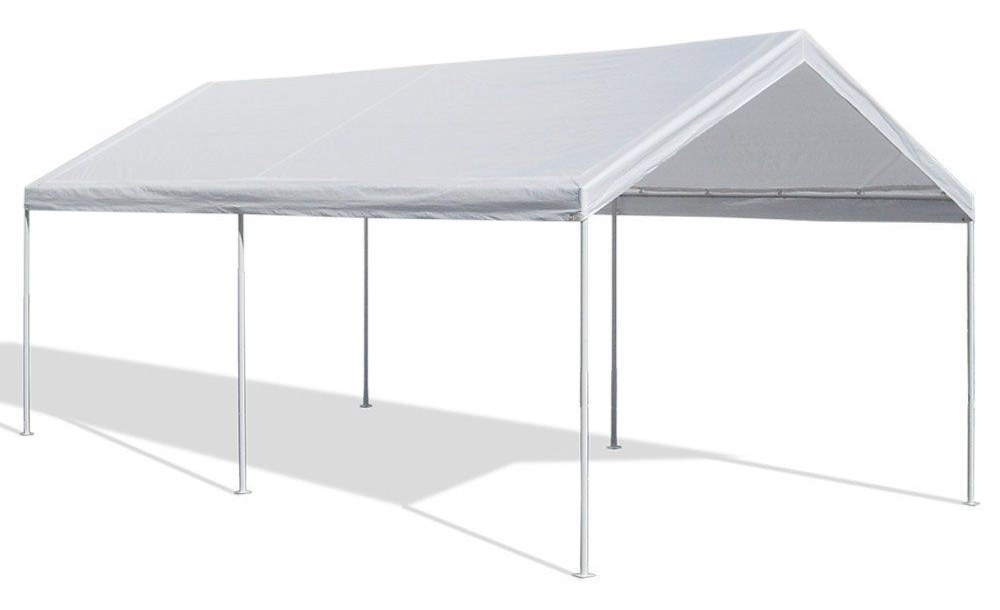
The frame is the part you photograph; the cover is the part you live with. A properly galvanized steel frame can stand for a decade and more, but the fabric over it is a consumable — and it is where every budget shelter saves its money. When customers send us photos of a failed shelter, the story is almost always the same: the frame is fine, slightly grimy, still square, and the cover above it looks like a shredded plastic bag.
So the real buying decision on a carport or storage shelter is not "which brand" — it is which fabric weight, for which climate, over which frame. Get that right and the shelter is a one-time purchase plus occasional cover renewals. Get it wrong and you own a good frame with a bad hat, and you pay for shipping twice.
What PE and PVC actually are
Polyethylene (PE) is a woven tape laminate — the material family of a serious tarpaulin. It is lightweight, fully waterproof and by far the cheapest cover to produce, which is why it is the standard fabric on our shelters at 200gsm. Its weakness is photochemical, not mechanical: UV slowly breaks the polymer down, so a PE cover fades, chalks and eventually tears at the fold lines. There is no "premium PE" that escapes this; there is only heavier PE, which buys seasons, not decades.
PVC-coated polyester is a different construction. A polyester base fabric carries a thick, plasticised PVC coating on both faces, and the panels are heat-welded together instead of sewn — so the seams are watertight by fusion, not by thread. At 450–650gsm it weighs several times what PE does, resists UV far better, shrugs off abrasion from branches and loading docks, and cleans with a hose. It costs more per square metre and lasts long enough to be the cheaper fabric per year of service.
The weight ladder: 200g PE to 650g PVC
Here is the decision table we give trade buyers, simplified to the four weights that matter:
| 200g PE | Standard cover, included in the base price. 2–3 seasons outdoors. Right for mild climates, seasonal vehicle storage, and buyers testing a first order. |
| 450g PVC | Permanent installations: year-round vehicle ports, workshop covers, warehouse overflow. 5+ years, heat-welded seams, replaceable without touching the frame. |
| 650g PVC | Top weight: high-abrasion sites, farms, coastal wind exposure, and the base fabric for our reinforced snow-load truss versions. |
| Colours | Green, grey and white are stock; any custom colour runs from volume orders — farms and fleets often match corporate or municipal colours. |
One honest note: white and light grey covers run measurably cooler inside than green in direct sun, which matters if the shelter stores fuel, feed or anything temperature-sensitive.
A second note on the comparison itself: we manufacture both, and we lose nothing by saying this — for a seasonal buyer on a budget, PE is genuinely the right call, and pushing PVC on that customer would be overselling. The fabric that fails buyers is not "cheap PE"; it is PE installed where PVC was needed — year-round duty, coastal salt air, or a snow region with a standard frame. Match the fabric to the duty cycle and both materials do their job.
Lifespan in seasons, not promises
Cover makers love quoting years. We prefer seasons, because that is how the failure actually arrives: a PE cover does not rot evenly — it chalks first, then the weave goes brittle along the ridges where the sun hits hardest, and the first tear opens on a windy day. 200g PE: 2–3 seasons. 450–650g PVC: 5+ years, and the oldest PVC covers we see still in service are pushing eight.
The part buyers miss: the cover is replaceable without touching the frame. Cover replacements ship folded in a carton, bolt through the same eyelets and rails, and fit in a car boot. So the rational way to buy is frame = capital, cover = maintenance. If your budget is tight this year, buy the good frame now and budget the PVC upgrade for next season — just make sure the frame you buy is engineered to carry the heavier cover.
A short care list stretches either fabric: keep the cover tensioned so it does not flap (flapping is what actually kills tarpaulins, not sunlight alone), hose the cover down once or twice a year to stop grime holding moisture, clear accumulated debris and standing water after storms, and check the anchoring points at the start of each season. None of this takes more than an afternoon a year, and it is the difference between a cover that reaches its rated lifespan and one that quits a season early.
Snow load: when fabric weight stops being the question
This is the section that saves people real money. In a mild climate, the fabric weight discussion above is the whole purchase decision. In a snow region, it is not: a standard carport frame with a heavier cover is not a snow solution. Snow is a structural load — wet snow can sit at 100+ kilograms per square metre — and no fabric weight compensates for insufficient truss spacing.
For snow regions we build reinforced truss versions with 450g+ PVC, engineered against the snow load at your location. The peak roof profile matters too: it sheds what a flat cover would hold. Send us your location and what the shelter protects, and we engineer the truss spacing and cover weight against your local numbers instead of guessing. With our truss system, widths run up to 12 metres — machine sheds and fleet ports included.
Sizing the shelter to what it protects
The size range runs from motorcycle to truck, and the common sizing mistake is measuring the vehicle and stopping there:
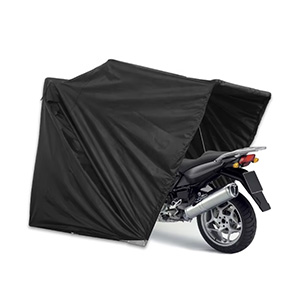
- 2x2m and 2x4m — compact shelters for motorcycles, garden equipment, tools and feed pallets. A customer favourite for tight courtyards.
- 3x6m — one car with working room, or a car plus shelving down one side.
- 4x6m and 4x8m — pickups, SUVs and small boats; the 4x8m fits a full-size pickup with a tonneau clearance.
- 6x12m — truck ports, RV and boat storage, farm machinery, or warehouse overflow racking.
Add 0.5–1m of clearance beyond the vehicle's length and width, and check height against roof racks, antennas and the tallest thing you will drive in — not the vehicle's spec sheet. The compact end of the range is below:
The frame: hot-dip galvanized after welding
Two steel frames can look identical in a listing and behave completely differently in year two. The difference is when the galvanizing happens. Our frame tubes — 38–76mm hot-dip galvanized steel — are galvanized after welding, so every weld, drill hole and cut end is coated. Cheap shelters use pre-galvanized tube that is welded afterwards, and welding burns the zinc off at the joint — which is precisely where rust starts, weeping orange stains down the leg within a season of coastal or wet-climate use.
The frame is also why we can promise a replaceable cover: the rails and eyelet points are sized to carry both fabric weights, so a 200g PE starter cover can be upgraded to PVC later without re-engineering anything.
Anchoring by surface, and what the build actually takes
A 6x12m shelter is a sail. Anchoring is not an accessory — it is half the engineering. We ship the kit that matches your surface: ground stakes or auger anchors for soft ground, expansion bolts for concrete with the base plates drill-marked so on-site positioning is mechanical, not exploratory. Tell us the surface when you order; it costs nothing and saves an ugly surprise.
As for the build: this is a bolt-together kit with hand tools only — two people, about half a day. No crane, no concrete pour, no specialist contractor for standard sizes. Parts arrive labelled and flat-packed, which has a second benefit buyers care about: flat cartons stack efficiently into containers, and freight is a real share of landed cost on steel products. The shipping-side arithmetic — FCL vs LCL vs DDP — is in our freight guide.
Where each model earns its keep
Across the orders we ship, six applications dominate:
- Car and motorcycle shelters — the core use; courtyard-scale models for bikes, driveway ports for cars.
- Boat and RV storage — long spans; the 6x12m with a PVC cover is the standard answer.
- Farm and feed storage — feed, straw and equipment under dry cover; farms usually step straight to 650g PVC because turnover never stops.
- Workshop covers — a dry, lit working bay next to the main building, at a fraction of a construction quote.
- Equipment and tool shelters — job sites and municipalities protecting assets between uses.
- Warehouse overflow — seasonal stock on racking under a 12m-wide truss span instead of a new lease.
The fabric logic follows the application: seasonal and mild-climate buyers are happy on PE; anyone running the shelter 365 days a year, near salt water or under snow, lands on PVC with the reinforced truss.
The budget math: what moves you from $60 to $480
Pricing runs from $60 to $480 per piece, FOB Dongguan, and four variables move you along that range. Footprint is the biggest lever — fabric and steel both scale with it. Frame grade is second: tube diameter and wall thickness step up with span. Fabric weight is third, and printing coverage fourth, if you want branding on the cover or valance. Volume discounts start at 10 pcs, which is also our MOQ — samples are negotiable if you want to put a fabric through one season before committing a fleet order.
Warranty is 1 year on frame and cover. We state that plainly rather than quoting five-year headlines the fine print then walks back — and in practice, a PVC cover on the right frame outlives the warranty by years.
Lead time, MOQ and how to order
Single-product carport orders run 7–12 working days production; mixed large orders — shelters plus flags, tables, or covers in different fabrics — run 12–18 days. Add freight and clearance on top, and plan the order backwards from when you need the shelter standing; the full method, including the Chinese holiday windows that catch first-time importers, is in our lead time guide.
The order information that actually speeds things up: shelter size, what it protects, your location (so we can check wind and snow exposure), your ground surface, and fabric preference. With those five facts, quotation is same-day and the engineering questions are already answered.
Next step
Send us the footprint you have in mind, what goes under it, and where in the world it will stand. We reply with a fabric recommendation for your climate, an anchoring kit matched to your surface, and a written production-and-shipping schedule against your date. The full range, specifications and price table live on the carport & storage shelter product page.