Shipping Tents from China: FCL vs LCL vs DDP — and What We Actually Recommend
The factory price of a custom canopy is rarely where the money is lost. It is lost between the factory gate and your warehouse: a minimum charge on a 0.9 cbm shipment, destination fees nobody quoted, or a DDP price built on a duty rate that no longer exists. This guide walks through the three shipping modes with real packed volumes for tents specifically.
Updated 20 October 2026 · Reading time about 8 minutes · By the Dtent logistics team
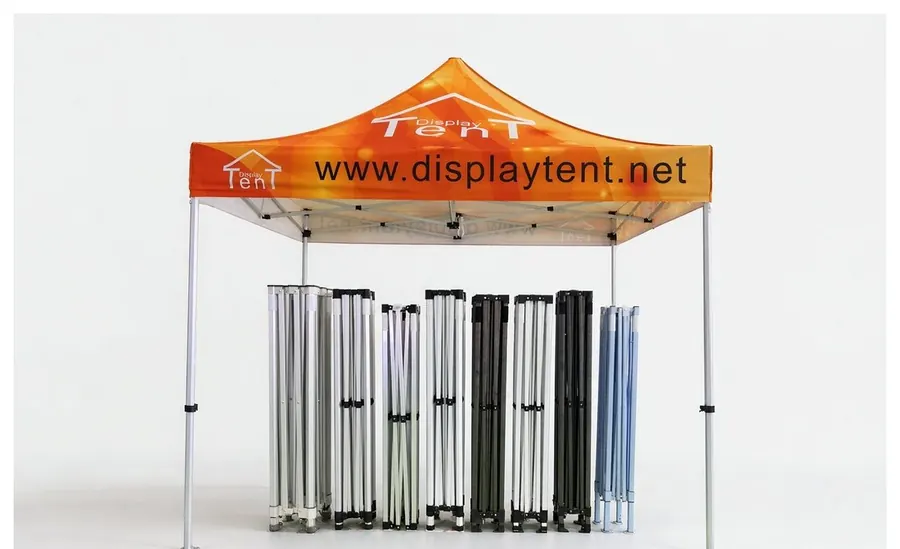
Why tents are a freight special case
Tents are light and bulky — the exact profile that ocean freight loves and air freight punishes. A packed 10 x 10 canopy weighs around 20–25 kg but occupies 0.16–0.20 cbm, so its freight cost is driven by volume, not weight. Everything in this guide follows from that one fact.
We ship containers out of Shenzhen, Ningbo and Yantian every week to distributors in the US, Germany, the UK and Australia. The questions below are the ones our buyers actually ask, answered with the packing numbers we use internally.
One caveat before the numbers: ocean rates move with season, fuel and route capacity. The figures here describe the structure of each shipping mode — which charges exist and when each mode wins — rather than this week's price. Ask us or your forwarder for a current quote before you build a margin.
Start with the packed volumes
Every shipping decision starts from how much space one unit takes. These are typical packed figures from our own packing list:
| Product | Packed size | Packed volume | Packed weight |
|---|---|---|---|
| 10 x 10 pop up canopy, wheeled bag | 1.6 × 0.35 × 0.3 m | 0.16–0.20 cbm | 18–25 kg |
| 10 x 15 pop up canopy, wheeled bag | 1.8 × 0.4 × 0.35 m | 0.26–0.33 cbm | 26–32 kg |
| Beach flag set (pole + base + banner) | 1.5 × 0.25 × 0.15 m | 0.06–0.08 cbm | 6–9 kg |
| Stretch table cover, folded | 0.5 × 0.4 × 0.1 m | 0.02 cbm | 2–3 kg |
| Beach umbrella, 2 m pole | 1.3 × 0.15 × 0.15 m | 0.03 cbm | 3–4 kg |
Notice what this table implies: one pallet position (roughly 1.2 × 0.8 × 1.6 m ≈ 1.5 cbm) holds seven or eight 10 x 10 canopies, forty table covers, or a mixed lot. Freight is a Tetris game, and the packing plan is worth real money.
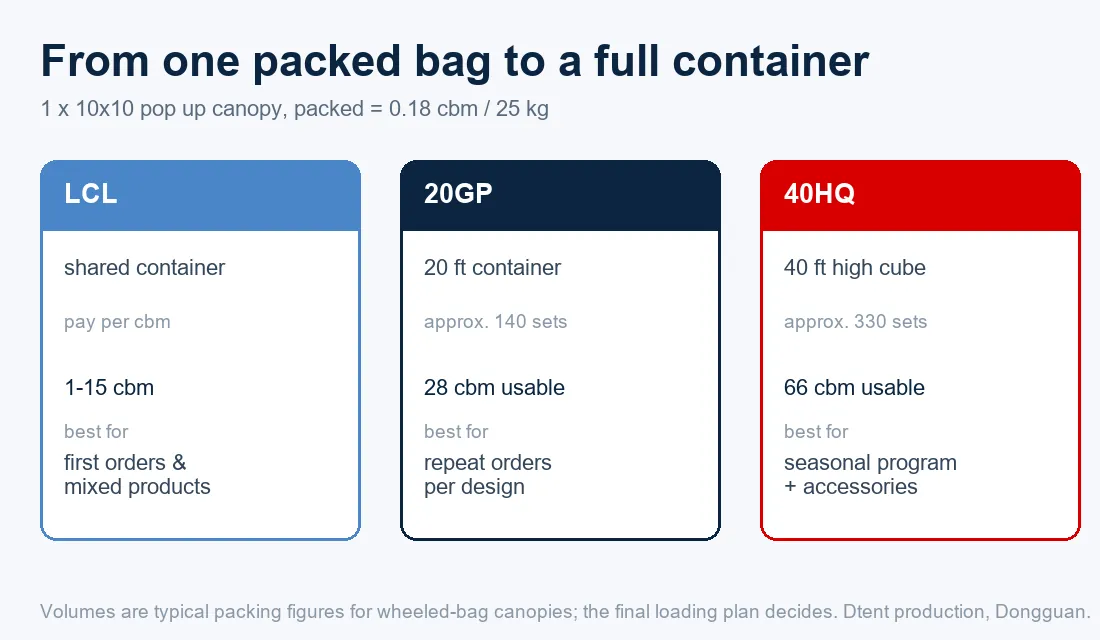
The container math in one picture
A 20 ft container (20GP) offers about 28 cbm of usable space; a 40 ft high cube (40HQ) about 66 cbm. Divided by our packed volumes:
- 20GP: roughly 130–150 sets of 10 x 10 canopy with wheeled bags, or a mixed load of 60 canopies plus flags and table covers for a season.
- 40HQ: roughly 300–340 canopy sets, or a full distributor program — canopies in three sizes, flags, table covers, umbrellas and spare parts in one load.
- Weight is never the constraint. Even 150 canopy sets weigh under 4 tonnes against a 20GP payload of about 25 tonnes. Tents always fill space long before they fill weight.
LCL — shared container, pay per cubic metre
Less-than-container-load means your cartons share space with other importers' cargo. You pay per cubic metre, with a minimum charge — typically 1–2 cbm regardless of actual volume.
LCL is the right mode for first orders, samples-plus-stock shipments and anything under roughly 12 cbm. A 3.5 cbm lot of twenty canopies ships as one clean LCL booking.
The part that surprises new importers is the charge structure. The ocean leg is priced per cbm and is often the smallest line. Origin handling, destination CFS (container freight station) charges, documentation and delivery are largely fixed per lot — so a 1 cbm shipment can cost nearly as much all-in as a 3 cbm shipment. The lesson: fill your LCL lot close to the point where the next cubic metre is nearly free.
- Best for: 1–12 cbm, mixed products, testing a new market.
- Watch out for: destination charges (get them quoted in writing), transit time 5–10 days longer than FCL, and more handling — pack cartons for forklifts, not for display.
FCL — your own container, cheapest per unit
From roughly 12–15 cbm upward, a full container wins. You pay one flat ocean rate for the box, the container is sealed at our factory and opened at your warehouse, and your cargo is handled exactly twice.
Per-unit freight falls steeply: a 20GP rate spread over 140 canopy sets is a fraction of the LCL cost per set. Just as valuable, FCL removes two risk factors — co-loaded cargo (another importer's leaky drum is not your problem) and destination CFS queues.
- Best for: repeat orders of one design, seasonal programs, distributor stock.
- Watch out for: the timing cliff. A missed vessel means waiting for the next sailing — during pre-summer peak season, that is often a week. Build the loading date into production planning, not after it.
DDP — one price, one invoice, zero paperwork
Delivered Duty Paid inverts the responsibility: we (or our forwarder) arrange ocean freight, export clearance, destination customs, import duties and final delivery. You receive one invoice covering everything and a carton at your door.
For a first-time importer without a customs broker, DDP removes the entire learning curve. For an experienced buyer it is rarely the cheapest option, for three reasons you should understand before accepting a DDP number:
- The duty rate inside the quote is an assumption. Canopies usually classify under HS 6306.22 (tents of synthetic fibres), and duty rates — including any additional duties on China-origin goods into the US — change over time. Ask which rate the quote assumes and check it is current.
- DDP contains a margin. The seller carries risk and paperwork, and prices that service in. It is a convenience fee, and sometimes a very fair one.
- You lose visibility. If the shipment stalls in customs, you are one step removed from the fix. A buyer who clears FOB/LCL through their own broker sees every problem immediately.
Our usual recommendation: DDP for your first order while you learn the landed-cost structure, then FOB or CIF through your own broker once volumes justify it — or stay on DDP with us if the all-in number remains competitive, which for many buyers it is.
The incoterms, in one table
| Term | Who arranges main freight | Who clears customs | Risk transfers to you |
|---|---|---|---|
| EXW (Ex Works) | You | You | At our factory gate |
| FOB (Free on Board) | You (your forwarder) | You, at destination | When goods are loaded on the vessel |
| CIF (Cost, Insurance, Freight) | We | You, at destination | When goods are loaded on the vessel |
| DDP (Delivered Duty Paid) | We | We, including duties | At your delivery address |
The middle ground matters: most experienced buyers land on FOB with their own forwarder, or CIF with our forwarder and their own broker at destination.
The documents that decide whether your container clears
Customs does not care how beautiful your canopy is. It cares about four or five pieces of paper:
- Commercial invoice and packing list — item description, quantity, unit value, total, and carton-by-carton contents. Descriptions like "display products" invite inspections; "aluminium frame pop up canopy, polyester fabric" closes questions.
- Bill of lading / airway bill — the transport contract and title document.
- Certificate of origin — where a trade agreement reduces duty, this document is the discount.
- Flame-retardancy certificates — NFPA 701 or CPAI-84 for US events, EN 13501-1 / DIN 4102 B1 for Europe. Not always demanded by customs, but demanded constantly by venues and organisers — order them with the goods, not after.
- ISPM-15 stamping — any wooden pallets or crates must be heat-treated and stamped, or the container can be rejected at destination.
Five mistakes that cost buyers real money
- Quoting freight by weight. Tents bill by volume on sea and by volumetric weight on air. A buyer who multiplies 25 kg by an air rate gets a number wildly above the real sea price — and sometimes skips a good deal because of it.
- Ignoring destination charges on LCL. The ocean leg quote looks small until the CFS, docs and delivery fees arrive. Always ask for the all-in estimate to your door before comparing modes.
- Under-declaring value. Customs valuation games risk seizure, fines and audits that follow your company for years. The margin you save is never worth the exposure.
- Approving artwork after the vessel cut-off. Production of 10–20 days plus printing plus booking lead time means the artwork deadline is usually 25–30 days before your event date. Late artwork does not delay shipping; it deletes the sailing you planned for.
- Forgetting the season peak. Chinese New Year (January–February) and the pre-summer export rush (March–May) stretch capacity for everyone. Orders placed in those windows should add 1–2 weeks of buffer, not zero.
How we recommend planning a first order
The sequence that works for most new buyers:
- Step 1 — sample by express (5–8 days door to door). One canopy with your printed roof, sent DAP or DDP by air. Feel the frame, check the print, show your team.
- Step 2 — first stock order by LCL or DDP. 10–40 sets, mixed products welcome. You learn real transit times and customs with modest exposure.
- Step 3 — repeat orders by FCL. Once annual volume passes roughly 60–80 sets, a 20GP twice a year beats four LCL lots — better unit pricing on the goods too, since production runs longer.
- Step 4 — keep a document folder. Invoice, packing list, B/L, origin certificate and flame certificates, one folder per shipment. Your future self, your accountant and your auditor all say thank you.
FAQ
How many pop up canopies fit in a 20ft container?
A 20 ft container offers about 28 cbm of usable space. A 10 x 10 ft canopy with frame, roof and wheeled bag packs at roughly 0.16–0.20 cbm and 20–25 kg, so a well-planned load holds around 130–150 sets. The exact number depends on the packing plan, bag dimensions and how many accessory cartons share the load — ask for the loading plan before you book.
Is LCL or FCL cheaper for 20 canopies?
For 20 canopies, LCL is cheaper. Twenty 10 x 10 sets occupy roughly 3.5–4 cbm, which bills as a small LCL lot. FCL only wins on cost per cubic metre from around 12–15 cbm upward — roughly 70–80 canopy sets — because the full container rate then spreads across more units and you avoid per-lot destination charges.
What does a DDP shipping quote include?
A true DDP quote covers ocean or air freight, export clearance, destination customs clearance, import duties and delivery to your door. You pay one invoice and handle no paperwork. It does not normally include unloading at your address, and make sure the quote states which HS code and duty rate it is built on — that is where DDP quotes vary most between suppliers.
What documents do I need to clear custom tents through customs?
The core set is a commercial invoice, packing list and bill of lading (or airway bill), plus a certificate of origin where a trade agreement reduces duty. Canopies and flags usually classify under HS 6306.22 (tents of synthetic fibres) or related headings. Many buyers also keep flame-retardancy certificates (NFPA 701 or CPAI-84 for the US, EN 13501-1 or DIN 4102 B1 for Europe) ready for organisers and venues. Your broker confirms the exact requirement for your destination.
How long does sea freight take from China to the US and Europe?
Port-to-port, expect roughly 14–20 days to the US West Coast and 30–38 days to North European ports. Add 3–7 days for customs clearance and 2–7 days for inland delivery. Air freight runs 5–8 days door to door. The common mistake is forgetting the 10–20 days of production before the vessel loads — plan from order date, not ship date.
Can I mix different products in one container?
Yes — consolidation is standard practice and we do it on most orders. Canopies, flags, table covers and umbrellas share a container with a consolidated packing list. Two cautions: on LCL a minimum charge of 1–2 cbm applies regardless of actual volume, and heavy small items should be loaded below bulky light ones so nothing gets crushed.
Next step
Tell us the product mix, quantity and destination port or postcode, and we will reply with the recommended mode, an all-in freight estimate and a production-plus-shipping schedule against your event dates — before you commit. Samples ship by express within days of artwork approval.