Screen Printing vs Sublimation vs Heat Transfer: Which Print Method for Your Custom Tent?
Every quote conversation eventually reaches the same fork: three printing methods, three different price structures, three different results on the fabric. Choose the wrong one and you either pay screen-setup fees for a photo that cannot be screened, or receive a washed-out logo that should have been a spot colour. This guide settles it in one read.
Updated 20 October 2026 · Reading time about 8 minutes · By the Dtent production team
Written by the people who run the machines
Dtent prints in-house in Dongguan: rotary screen printing, wide-format dye sublimation and heat transfer all run on the same floor, often on the same order. That gives us an unusual position — we have no method to sell you. The method we recommend is simply the one that fits your artwork, quantity and budget.
Most printing problems we see are not factory errors. They are method mismatches: a gradient-rich photograph forced into screens, a two-colour logo sublimated onto fabric where the navy drifted grey, a one-piece order quoted with four screen charges nobody mentioned.
Below is how each method works, an honest comparison table, the durability numbers from our own wash and weather tests, and a decision list you can apply to your own artwork in two minutes.
The three methods in one paragraph each
Screen printing pushes ink through a fine mesh screen, one screen per colour. Each colour in your artwork becomes a physical film and screen; the ink sits on the surface and is cured under heat. It is the oldest method on our floor and still the strongest for bold, solid logos on dark fabric.
Dye sublimation prints your design in CMYK onto transfer paper, then a calender presses paper and polyester together at around 200 °C. The dye turns to gas and bonds inside the fibre itself. The print is literally part of the fabric — it cannot be felt with a finger and cannot crack off.
Heat transfer prints the design onto a carrier film or vinyl and presses it onto the fabric as a layered sheet. Think of it as a sticker fused to the cloth. It is fast, cheap for one-offs and the least demanding about artwork — but the print sits on top, adds a slightly rubbery hand-feel and has the shortest life of the three.
The honest comparison table
This is the table our sales engineers keep open on the second monitor. Read it before you read anything else.
| Factor | Screen printing | Dye sublimation | Heat transfer |
|---|---|---|---|
| Setup cost per design | 15–40 USD per colour | File prep only | File prep only |
| Unit cost at 50+ pieces | Lowest | Low | Medium |
| Unit cost for 1 piece | Highest — setup dominates | Low | Lowest |
| Colours | Solid spot colours only | Full CMYK + gradients | Full CMYK + gradients |
| Pantone accuracy | Exact — spot ink | Approximate (ΔE 3–5) | Approximate (ΔE 4–6) |
| Photographs & gradients | No | Yes | Yes |
| Outdoor life | 3–5 seasons | 3–5 seasons | 1–2 seasons |
| Feel on fabric | Thin ink layer | None — inside the fibre | Noticeable film layer |
| Minimum order | ~5–10 units | 1 unit | 1 unit |
| Typical turnaround | 7–10 days | 5–7 days | 3–5 days |
Figures are typical for polyester oxford 420D–600D canopy fabric at our Dongguan plant; they shift with fabric weight, ink coverage and season. Ask your sales engineer for current numbers.
Screen printing: the fleet method
Screen printing wins when one design repeats across many units. Once the screens exist, every additional canopy costs pennies of ink and minutes of machine time. A corporate customer ordering 60 identical roofs for a dealer network will get the lowest price per roof we can offer — usually 20–30% below the same roof sublimated.
The second advantage is colour authority. Because each colour is mixed as a spot ink, Pantone 485 C comes off the line as Pantone 485 C — not a CMYK approximation. Brand managers who police their logo colours care about this more than any other factor, and it is the single most common reason a buyer chooses screens over sublimation.
The limitations are just as clear:
- Every colour costs a screen. A four-colour logo on one order carries four setup charges — and on a ten-piece run, that setup can be half the invoice.
- No gradients, no photographs. A sunset, a skin tone, a shading effect — none of it survives screening.
- Registration on dark fabric. On navy or black roofs the design first needs a white underbase layer, adding one more screen and one more cost.
Dye sublimation: the detail method
Sublimation is what you choose when the artwork itself is the message — full-bleed photographic roofs, gradient sunsets, festival branding, edge-to-edge patterns with dozens of colours. Because the press prints in CMYK from a digital file, colour count is free: fifty colours cost the same as two.
Its durability on polyester is the best we measure. The dye is inside the fibre, so folding, rolling and UV exposure wear the fabric long before they touch the colour. Our salt-spray and xenon-arc tests on sublimated 600D polyester show under 8% fade after the equivalent of two full outdoor seasons — better than any surface ink we run.
Two caveats matter:
- It only works on polyester. Sublimation dye bonds with polyester molecules; it does nothing on cotton, canvas or PVC-coated fabrics. If your specification requires those materials, the print method is decided for you.
- CMYK colour is an approximation. We convert Pantone references and always photograph a printed swatch for approval — but if your brand guideline specifies an exact spot colour on a large area, discuss it before the order, not after delivery.
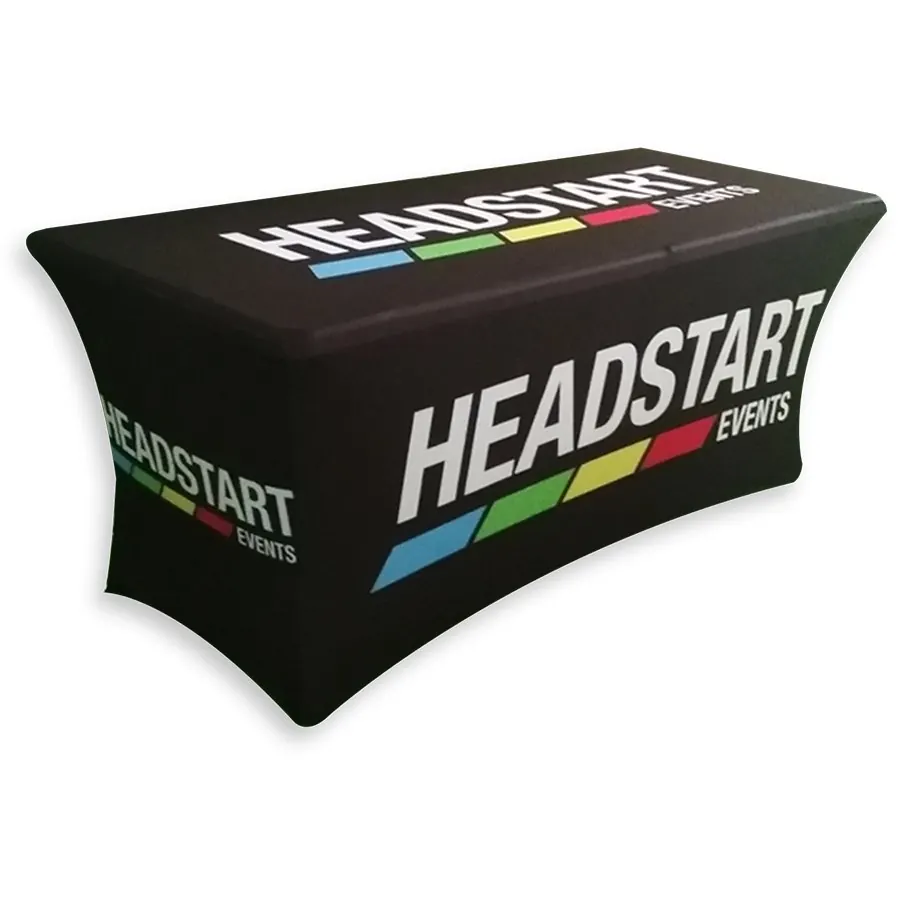
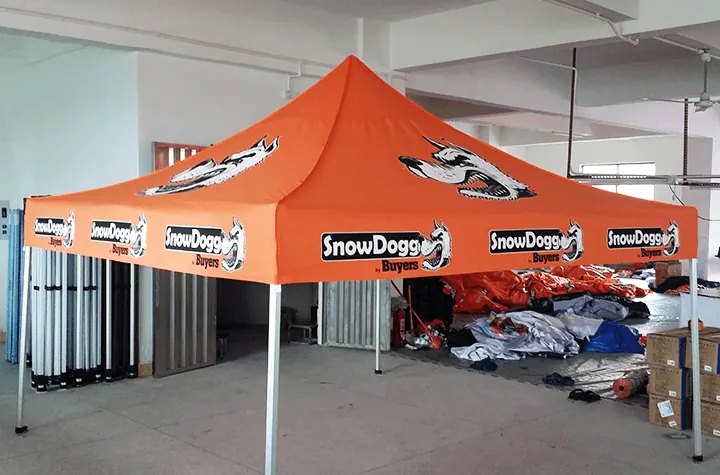
Left: screen printing at its best — bold solid logos at fleet scale. Right: sublimation at its best — full-colour edge-to-edge coverage on a stretch table cover.
Heat transfer: the fast one-off method
Heat transfer earns its place on three jobs: sampling, small events and repairs. Need one canopy for a wedding next week, or a replacement valance for a five-year-old fleet? Transfer presses in a day, accepts any artwork and costs the least for a single piece.
Be honest about its limits, though. The printed film sits on the surface, so repeated folding along the same crease eventually cracks it — expect one to two seasons of regular outdoor use. It also adds weight and a slightly plastic hand-feel on large coverage areas. For a name tag, a sponsor patch or a one-off event, none of that matters. For a roof that lives in a wheeled bag between fifty events a year, it does.
What we recommend, product by product
After a decade of running all three methods, this is the default pairing on our floor:
- Pop up canopy roofs and walls: screen printing for fleets of one design; sublimation for full-bleed or photographic designs; heat transfer for one-offs and sampling.
- Beach flags: sublimation, always. Flags need print-through on the reverse and gradients are common — both are sublimation territory.
- Table covers: sublimation for full-colour designs; screen printing for simple two-colour logos on large runs; transfer for single replacement pieces.
- Umbrellas and inflatables: sublimation on polyester panels; spot screen printing where a single Pantone must be exact.
One order can mix methods without penalty: a screen-printed roof, sublimated flags and a sublimated table cover ship together, and the design system stays visually consistent across all of them.
Three artwork mistakes that cost buyers money
Most print problems start in the artwork file, not on the press. Three come up every week:
- JPEG logos from a website. A 400-pixel logo pulled from a webpage cannot be screened or sublimated at roof size — it will pixelate. Always send the original vector file (AI, PDF or EPS) from your designer; every brand has one archived somewhere.
- Pantone references on photographs. Pick one: a photo printed in CMYK, or flat graphics matched to Pantone. Mixing a "Pantone-exact" demand onto a gradient-heavy design forces compromises on both.
- Colour specified from a phone screen. Screens glow; fabric does not. A colour that looks right on an iPhone is not a specification. Send Pantone references or ask us to post a printed swatch — it costs one day and prevents the only dispute we cannot settle after delivery.
How to decide in two minutes
- More than 10 units of the same design, one to four solid colours? → Screen printing.
- Photographs, gradients or dozens of colours? → Dye sublimation.
- An exact Pantone that brand guidelines enforce? → Screen printing.
- One piece, needed fast? → Heat transfer.
- Flags or print-through required? → Dye sublimation.
- Unsure? Send the artwork — we reply with the method, the price at each quantity and a mock-up, with no obligation.
FAQ
Which printing method lasts longest on a canopy?
For polyester canopies, dye sublimation lasts longest: the dye bonds inside the fibre, so it cannot crack or peel, and a roof typically holds 3–5 seasons of outdoor use. Screen printing with solvent-based inks is equally weather-proof but sits on top of the fabric, so sharp folds over years can cause fine cracking at the crease lines. Heat transfer is the least durable of the three and is best reserved for short campaigns.
Can you match an exact Pantone colour?
Screen printing can, because each colour is mixed as a spot ink from Pantone solid-coated references. Dye sublimation prints in CMYK, so we convert your Pantone to the nearest CMYK value — most colours land within Delta-E 3–5, but vivid oranges, deep navy and metallic effects are the hardest to hit. We always send a printed mock-up photo for approval before production.
What artwork files do you need for each method?
Screen printing needs vector artwork — AI, PDF or EPS with text converted to outlines — because every colour becomes a separate film screen. Sublimation and heat transfer accept either vector files or high-resolution raster images, ideally 150 dpi or more at full print size, since photographic detail reproduces well. JPEG logos downloaded from a website are not usable for any method.
Which method is cheapest for a single canopy?
Heat transfer or sublimation. Screen printing carries a one-off setup cost per colour — typically 15–40 USD per screen — which on a one-piece order can exceed the printing itself. Sublimation has no screens to make, so a single fully printed canopy costs about the same per unit as a run of fifty, minus a small file-preparation fee.
Can you print photographs or colour gradients on a tent?
Only sublimation and heat transfer can. They reproduce photographic images and smooth gradients because colour is built from CMYK dots. Screen printing lays down solid spot colours and handles gradients poorly — each shade shift needs another screen, and a photorealistic print would need dozens of them.
What is the minimum order for each printing method?
Sublimation and heat transfer start at one piece. Screen printing becomes economical from roughly 5–10 units per design, because the screen setup is amortised across the run. Many buyers combine methods: one screen-printed roof repeated across a fleet, plus sublimated flags and table covers for the colourful extras.
Next step
Send us your artwork file and target quantity, and we will come back within one business day with the recommended method, unit pricing at 1 / 10 / 50 pieces and a free digital mock-up of your design on the product. If you want to feel the difference first, we can post a printed fabric swatch before you confirm.