What's in a 10x10 Trade Show Booth Kit? A Complete Breakdown
Most first-time exhibitors buy a canopy, then discover at the venue that a canopy alone is not a booth. No backwall, so the hall's rear curtain shows through. No table cover, so a plastic folding table sits in the middle of the brand story. No weights, so the whole thing leans in the first gust. A booth kit exists to close that gap — but the word "kit" hides wildly different contents. Here is exactly what goes into ours, tier by tier, and how to spec one without overbuying.
Updated 7 November 2026 · Reading time about 8 minutes · By the Dtent boothkit team
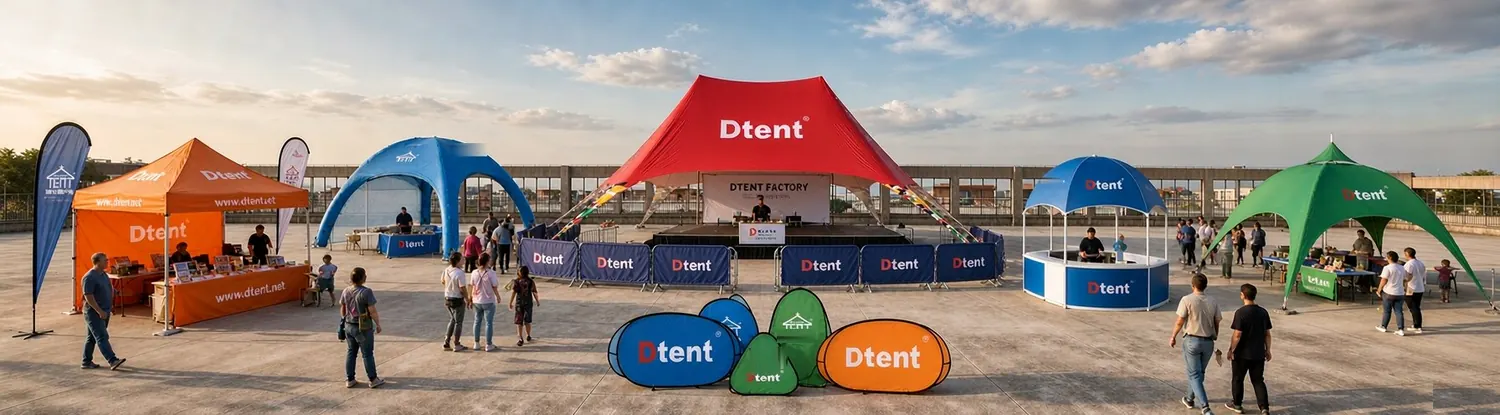
A kit is a system, not a discount bundle
The reason to buy a kit has nothing to do with saving a few dollars per item. It is that all the printed pieces have to look like they were made together — same red, same blue, same logo size, same fabric sheen. When four suppliers print four pieces, you get four versions of your brand colour and a booth that looks assembled rather than designed. Sponsors and buyers read that instantly, even if they cannot say why.
A kit also solves a logistics problem nobody warns you about: one purchase order, one artwork approval, one packing list, one shipment, one arrival date. Ask anyone who has chased a late flag shipment two days before a show and you will hear the same answer — they now buy the whole booth from one factory.
The three tiers we build most
Every kit is quoted individually, but almost every order lands on one of three shapes. This table is the fastest way to see where your booth sits:
| Starter | 1 printed 10x10 canopy · 1 feather or teardrop flag · 1 printed 6ft table cover · 2 sandbags · 1 roller bag. For popup markets, weekend fairs and single-table setups. |
| Standard | 1 printed 10x10 canopy · 2 flags · printed 6ft table cover · printed backwall · optional half sidewalls · 4 sandbags · 2 roller bags. The trade-show default — closes the back, brands the table, gives height at the aisle. |
| Premium | 1 printed 10x10 canopy · 4 flags · printed table cover · printed backwall · half sidewalls · reception counter · 4 sandbags · 3 roller bags. For roadshows and dealer showrooms where the booth has to work for a season, not a weekend. |
Standard kits run from about $209 to $680 per kit depending on canopy size, print coverage and how many pieces are branded. The spread is wide because "10x10 kit" can mean a plain canopy with a table cover, or a fully printed booth with four flags and a counter. Ask for the item list behind any quote — including ours — before comparing prices across suppliers.
The four kit configurations we ship most
Beyond the tiers, repeat customers tend to settle into one of four configurations, because each one answers a specific booth problem:
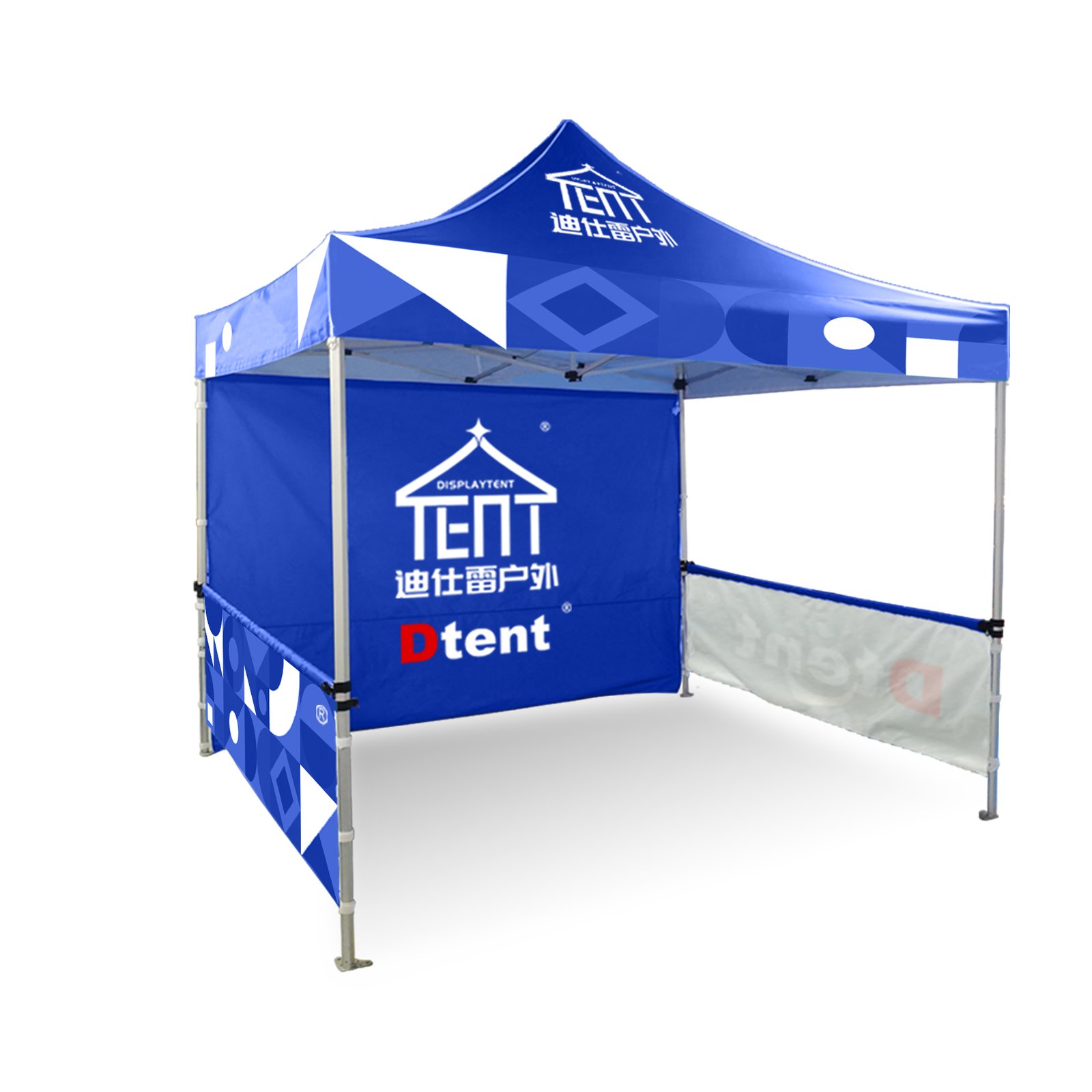
| Kit A | Canopy + backwall + table cover — the fastest way to look professional on a small budget |
| Kit B | Canopy + sidewalls + 2 flags — for aisle positions where you need to control sightlines |
| Kit C | Full printed wall set — a sealed booth for meeting rooms and product demos |
| Kit D | Flags + counter + full set — the roadshow kit, packs into three bags and rebuilds in an hour |
Item by item: what each piece is actually doing
When you know the job each item performs, cutting the wrong one becomes obvious:
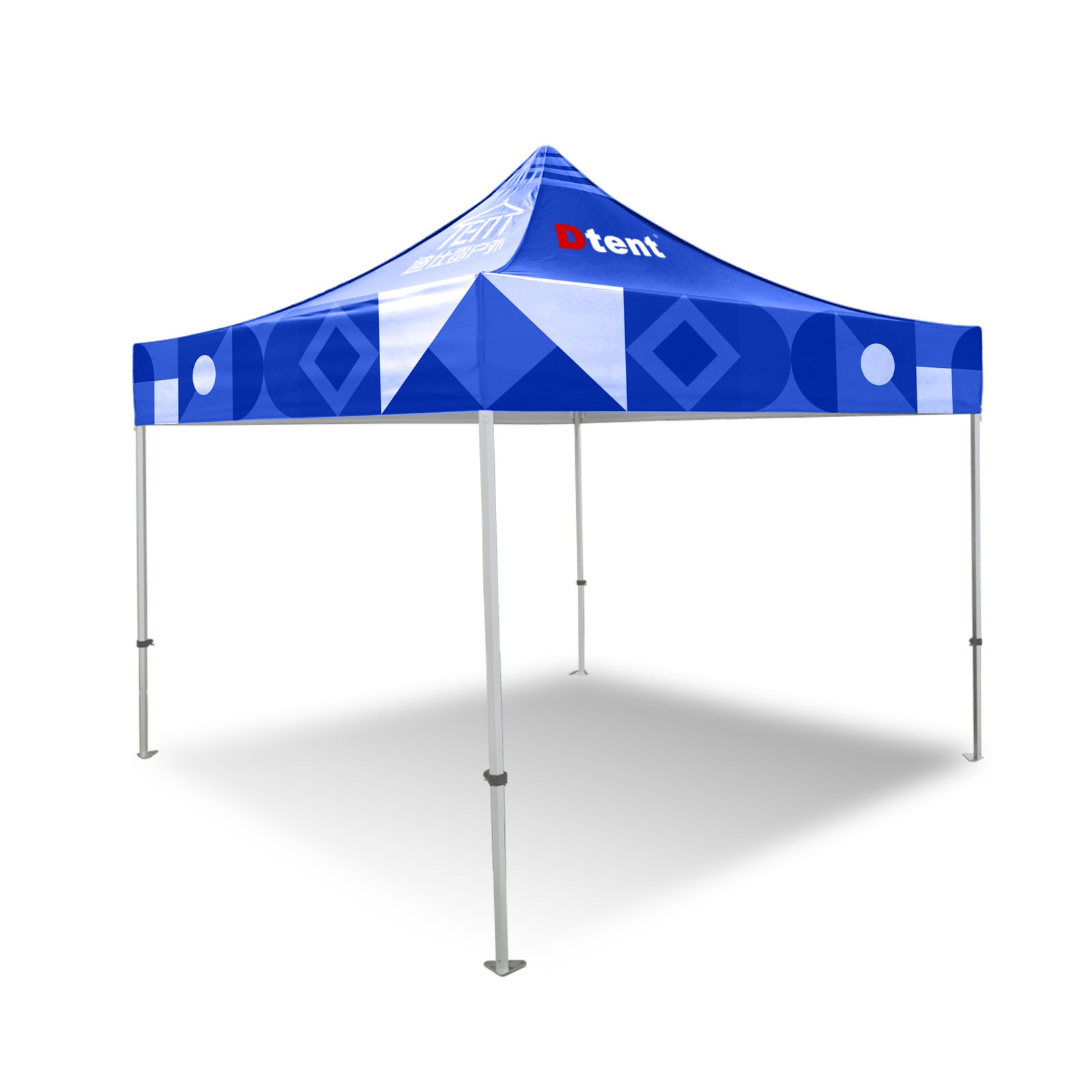
- Printed canopy. Roof and valance carry the brand at height, readable across an aisle. 10x10 is the standard US booth; 10x15 and 10x20 suit double or corner positions. Oxford or 600D polyester, dye-sublimated, with a wheeled bag.
- Backwall. Stops the hall's grey curtain from becoming your background and gives you a flat surface for product shelving, screens and graphics. In our experience this single piece changes how a booth is read more than any other.
- Half sidewalls. Close one or two sides to create a meeting corner or to hide stock boxes — and to stop the wind tunnel effect between neighbouring booths.
- Fitted table cover. A 6ft table is the most common piece of furniture on any show floor and the most commonly left unbranded. A fitted cover with a printed front panel turns it into a counter.
- Feather and teardrop flags. Height above the crowd line. Two flags at the aisle corners is the cheapest way to be findable from 30 metres away.
- Reception counter. Folds out of a case, gives standing height for conversations and hides the cables, bags and catalogues that otherwise live on the floor.
- Sandbags and roller bags. Unglamorous, non-negotiable. Four sandbags on an open 10x10 is the difference between a booth and a sail.
Sizing the kit to your footprint
Booth size drives the kit more than budget does. Three common cases:
| 10x10, one open side | Canopy + backwall + table cover + 1–2 flags. Keep the counter at the open corner, never in the middle — it blocks the entry line. |
| 10x20, two open sides | Two canopies or one 10x20 frame + backwall across the long side + two half sidewalls + 2–4 flags. Split the space: display at the aisle, meeting area at the back. |
| Corner or island | Full printed walls on the closed sides only; leave every open side free of sidewalls. Flags at the corners do the wayfinding that walls would otherwise do. |
One rule that saves arguments with show organizers: measure the assigned space, not the booth you drew. Canopy legs sit inside the boundary, but flags and counters often do not, and a counter 20 cm into the aisle will be moved by venue staff at the worst possible moment.
What a kit does not include — and why we say so
No kit from any factory covers the whole booth. Ours deliberately stops at printed structure. Not included: lighting and track spots, flooring and carpet, AV screens, electrical distribution, chairs and lounge furniture, plants, and the labour to install any of it.
There is a practical reason. Lighting and flooring are heavy, fragile and region-specific — they are almost always cheaper to rent from the show contractor than to ship from China, and rented items arrive with someone else responsible for them. We would rather ship you a kit that arrives complete for what it promises than one padded with items you will pay freight on twice.
What we do include is the part that must match: colour. Every printed piece in the kit comes off the same dye-sublimation line with the same colour profile, so the canopy valance and the table cover front are the same red under show lighting.
Packing, weight and freight math
This is where kit orders are won or lost on cost, and where vague suppliers cost you money:
| Cartons per standard 10x10 kit | 2–4 (canopy, walls/backwall, table cover and flags, counter if included) |
| Gross weight | roughly 22–32 kg for a standard kit; a premium kit with counter runs 30–40 kg |
| Volume | roughly 0.15–0.25 CBM standard, 0.25–0.35 CBM premium |
| 20ft container | approximately 110–150 kits |
| 40ft high cube | approximately 270–380 kits |
Two consequences follow. First, a kit is air-freightable when a show date moves — 30 kg is nothing, and that option has saved more than one launch. Second, kits consolidate well: because walls, covers and flags pack flat, the marginal cost of adding two flags or an extra table cover to an existing carton is close to zero. That is the argument for ordering the whole booth at once rather than in three separate shipments. The full freight decision tree — FCL, LCL or DDP — is in our shipping guide.
Setup: what two people can do in an hour
Realistic numbers from customers who set these up every month: canopy frame open and roof on, 8–12 minutes with two people; backwall zipped on, 5–8 minutes; half sidewalls, 3–4 minutes each; table cover fitted, 2 minutes; flags assembled and based, 4–5 minutes each; counter folded out, 2 minutes. A standard kit lands at 30–45 minutes, a premium kit at about an hour.
No tools. The pieces are labelled to match frame legs, which matters more than it sounds — the first setup of any new kit is slower while you work out orientation, and labels remove that hour of confusion on a show morning.
Artwork: one design system, many shapes
Kits fail visually for a predictable reason: artwork is designed for the canopy and then stretched onto the table cover and flags. The fix is to design a system instead of a poster. Decide three things before touching files — the logo's minimum size across the whole booth, one accent colour used identically everywhere, and where the headline lives on each surface.
Technically, send vector artwork (AI, EPS, PDF) at 1:10 or full size with fonts outlined, and ask for a numbered proof sheet covering every printed piece. We supply dielines for each item in the kit — canopy valance, backwall, sidewall, table cover front, flag — so nothing gets cropped by a seam. Repeat orders keep the approved files on record, which is why reorders ship faster than first orders.
Kit economics for dealers and resellers
If you resell booths rather than exhibit in them, kits do something useful to your business: they collapse a long SKU list into a few sellable configurations. Instead of quoting a canopy, then a backwall, then a table cover, then flags, you quote "Standard 10x10 booth" at one price with a known margin, and the customer understands what they are buying.
Dealers typically stock the Starter and Standard tiers in the most common colourway, then order Premium configurations to demand. Because our minimum is one piece, that model does not need container-scale commitments — you can test a market with ten kits and scale from there. Custom packaging and neutral labels are available if you sell under your own brand.
How to spec your kit in one message
Send these five things and a quote comes back the same business day, with a mock-up:
- Booth footprint and how many sides are open (10x10 one side, 10x20 corner, island)
- What the booth has to do — sell product, book meetings, demo, recruit
- Item list you think you need, or the tier you are considering
- Logo files and brand colours (Pantone references if you have them)
- Event date and destination city, so the shipping method can be costed properly
Production is 7–12 working days after artwork approval for standard kits, 12–18 days for large mixed orders. Add proofing and transit, and the comfortable order point is six to eight weeks before a US show, eight to ten for Europe. If your date is closer than that, say so in the first message — we will tell you honestly whether air freight closes the gap.
Next step
The full tier comparison, size options and item list live on our canopy tent packages page. If you are still deciding between a kit and buying pieces separately, the canopy buying guide covers frame, fabric and printing choices in detail — and the lead time guide explains how to plan backwards from an event date.