Sealed vs Continuous-Blown Inflatable Tents: Which One Should You Buy?
Every inflatable enquiry that reaches our factory floor starts with the same fork in the road: sealed (airtight) or continuous-blown. It is the decision that determines your power plan, your noise level, your multi-day usability — and roughly half the price. This guide explains how each type actually works, where each one wins, and the sizing, fabric and anchoring choices that follow from it, from the perspective of the people who weld the seams.
Updated 16 November 2026 · Reading time about 8 minutes · By the Dtent inflatables team
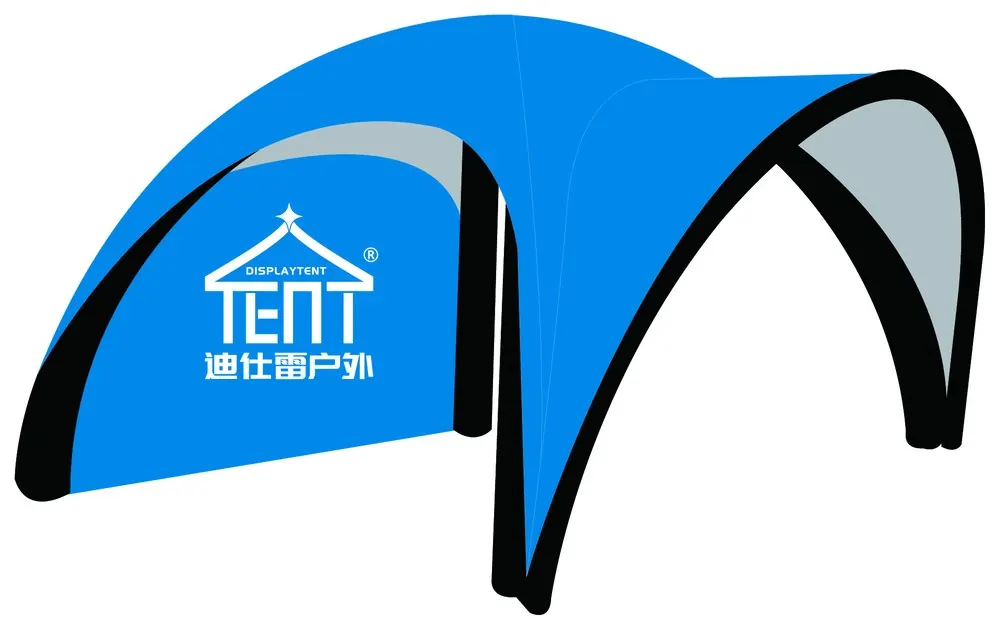
The decision that shapes everything else
Buyers usually arrive asking about size or printing. Both matter, but they are downstream decisions. The first question that actually determines what we build is: does the structure hold air by itself, or does a blower keep it alive? Get this wrong and the consequences show up on site, not on the invoice — a silent sealed dome at a wedding where a roaring blower would have been unacceptable, or a blown tent deflating quietly at hour six of a trade show because someone unplugged it to boil a kettle.
The good news: this is a two-question decision. How many days is the event? And how reliable is the power? Everything else in this article is elaboration on those two questions.
How a sealed (airtight) inflatable actually works
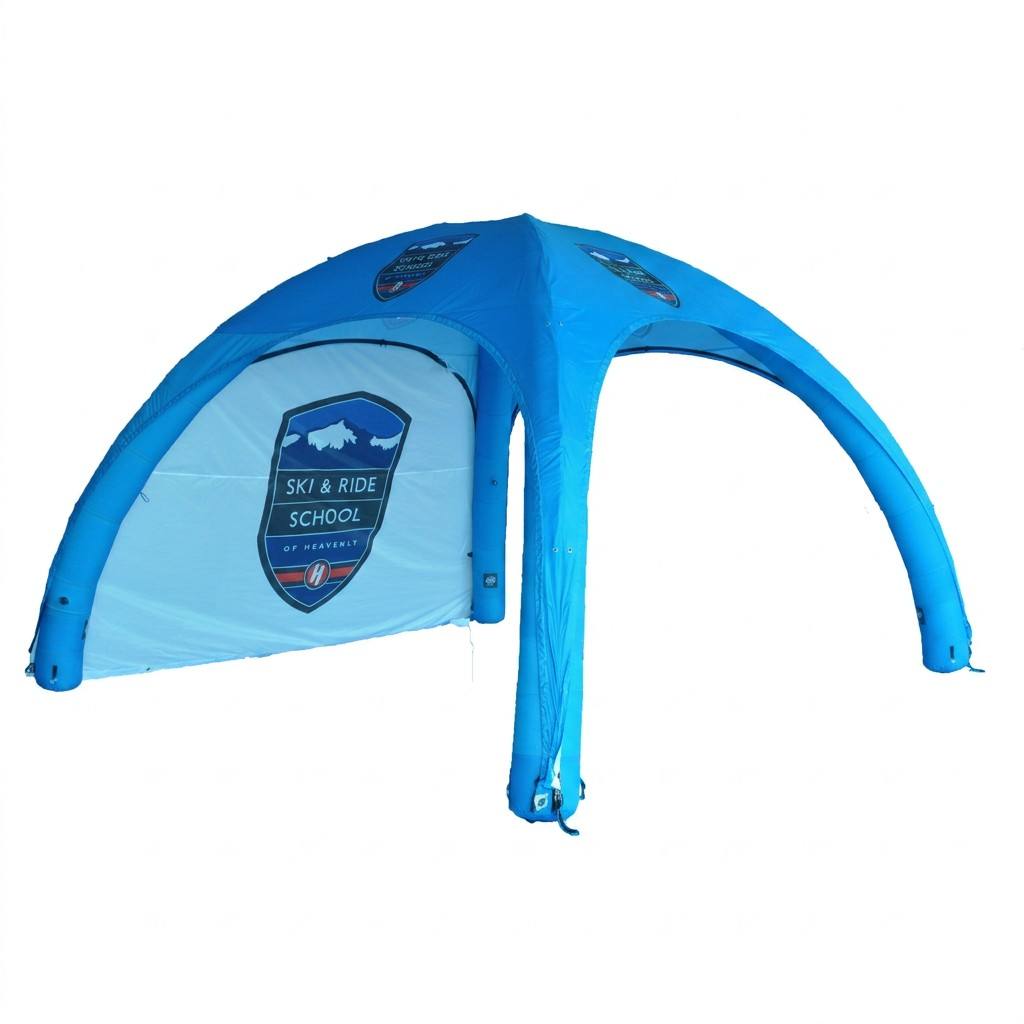
A sealed inflatable is built like a high-quality air mattress. The skin is made from PVC tarpaulin with welded (heat-fused) seams instead of sewn ones, and it uses industry-standard airtight zippers on any access panels. Inflate it once with the included pump, close the valves, and the structure holds pressure on its own — our domes hold for 3–5 days, and a two-minute top-up brings them back to spec.
Because no blower runs after inflation, the tent is silent. That single property decides most sealed purchases: weddings, hotel installs, museum atriums, TV sets, shopping-mall activations — anywhere a constant mechanical hum would be a problem, sealed wins by default. It also means the tent does not care about power cuts, generator failures or a cleaner unplugging "the noisy box" to vacuum.
The trade-offs: sealed construction costs more (welding is slower than sewing), the PVC fabric is heavier than Oxford cloth, and if the structure is punctured it loses pressure gradually rather than instantly — the repair patch kit in every shipment handles the common cases in minutes.
How a continuous-blown inflatable works
A continuous-blown inflatable is the classic festival look. The fabric — lighter 210D or 420D Oxford with sewn seams — is deliberately air-permeable, and an electric blower pushes air in continuously to replace what leaks out. The structure stays rigid because the blower never stops.
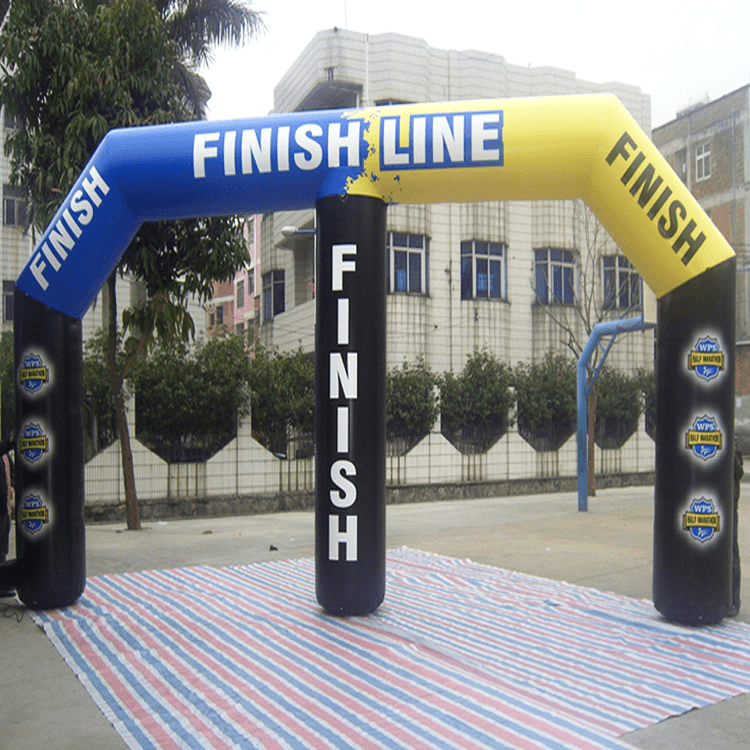
This construction is lighter to ship, faster to deploy and cheaper to buy, which is why it dominates short outdoor events: start/finish arches at races, festival entrances, one-day product launches. There is also a hidden safety property buyers rarely consider: a blown structure cannot over-pressurize, and if the skin tears, the blower compensates — the event keeps running while you patch. With power present, a blown tent is the most forgiving thing on site.
The trade-offs are the mirror image: it needs power for the entire event, it hums, and if the blower stops, the tent deflates at a speed that is noticeable but never dangerous — it settles like a slow bouncy castle, it does not collapse.
Side by side: the comparison table
| Construction | Welded PVC seams, airtight zippers | Sewn Oxford seams, air-permeable |
| Power on site | Only for initial inflation (pump) | Blower runs continuously |
| Noise | Silent once up | Constant blower hum |
| Hold time | 3–5 days per inflation | Up as long as power holds |
| Best fabric | 0.4–0.55 mm PVC tarpaulin | 210D / 420D Oxford |
| Weight & shipping | Heavier, bulkier | Lighter, smaller pack |
| Price position | Upper half of the range | Budget-friendly end |
| Natural habitat | Multi-day installs, indoor venues, quiet sites | Short outdoor events with power access |
Our inflatable line spans $288–$988 per piece FOB Dongguan, and type is one of the biggest variables inside that range — a small blown arch sits at the bottom, a large sealed PVC dome with windows sits near the top. Volume discounts apply from 10 pieces, and MOQ is 1, so starting with one hero unit is completely normal.
Where each type wins
Sealed inflatables win in these situations:
- Multi-day installs. Weddings and garden parties that run a weekend, mall activations that run a fortnight. Inflate Friday morning, top up Tuesday, done.
- Indoor venues. No power tentacles across polished floors, no hum under speeches. Hotels and exhibition halls love sealed for this reason alone.
- Media and broadcast. Cameras pick up audio you cannot hear live. Sealed is the only safe answer on a filmed set.
- Clear-window builds. Transparent PVC sections pair naturally with sealed construction — a lit-up branded dome at night is one of the highest-photo-value units we make, and our domes are LED ready.
Continuous-blown wins in these situations:
- Short events with power. A one-day race, festival or launch. The blower cost nothing overnight because there is no overnight.
- Budget-driven orders. Same printed impact, lower unit price and cheaper freight — this matters when the order is 10 arches for 10 city tours.
- Frequent setup/teardown. Lighter fabric and smaller packed size mean one person can move it; setup runs 10–20 minutes with 1–2 people for both types, but the blown units are kinder on stairs and small vans.
- Arches and gates. Almost all event arches are blown — the shape tolerates constant airflow perfectly and nobody minds a blower at a start line.
Power, noise and site planning
If you go continuous-blown, plan power like an event professional: one dedicated outlet per blower (daisy-chaining extension leads is the classic rookie failure), a generator sized with headroom for startup surge, and the blower positioned where it cannot be kicked, rained into or unplugged. Ask us for the blower wattage of your specific unit and your electrician or generator supplier can size it in one line.
If you go sealed, your only power requirement is the initial pump — a power bank, a car socket or any wall outlet. This is why sealed units are the default recommendation for clients whose "site survey" is a photo of a beautiful lawn with no sockets in sight.
Choosing your size: 3m to 10m domes
Our domes come in 3m / 5m / 8m / 10m diameter, and the right size is a function of what happens inside, not just headcount:
| 3m dome | One-on-one sampling, photo pod, small retail counter — 1 staff + 2–3 guests |
| 5m dome | The workhorse. Counter plus display shelving, 4–6 guests, fits a standard booth footprint |
| 8m dome | Bar, lounge or mini-showroom; seating for 10+; still truck-friendly |
| 10m dome | Marquee replacement for weddings and hospitality zones — check venue freight access first |
A rule from our sampling clients: the throughput math matters more than the diameter. How many guests per hour, how much counter surface, where does the queue form — that calculation, not the catalogue, should pick your size. We walk through it in detail in our dome sizing guide, and the same logic transfers to inflatable domes.
Oxford or PVC: picking the fabric
The fabric choice usually follows from the type decision, but a few nuances are worth knowing. 210D and 420D Oxford are woven polyester with a coating: light, packs small, prints beautifully with digital ink, ideal for blown structures and for anything carried by a two-person team. 0.4–0.55 mm PVC tarpaulin is a welded, airtight film-backed material: heavier, far more airtight, and the only option for sealed builds; it also shrugs off abrasive ground better, which matters for week-long installs on grass or gravel.
Print quality is excellent on both — full-surface, weather-resistant digital printing comes standard on every unit we ship. If your artwork has photographic content or fine gradients, tell us at enquiry stage; it changes which fabric surface we recommend for the outer skin.
Wind, anchoring and honest limits
Every inflatable ships with an anchoring kit: stakes for grass and sand, and provision for ballast on hard surfaces. An inflated structure is more stable than people expect — the skin flexes and recovers rather than loading up like a rigid sail. But honesty is a better sales policy than bravado: in sustained high winds or storms, deflate and re-erect when it eases, the same call a sensible organizer makes for any temporary structure, tents included. For a longer treatment of anchoring physics and take-down thresholds, see our canopy wind guide — the principles carry over.
One practical tip from the factory floor: the most common inflatable incident we hear about is not wind. It is a blown tent whose blower got unplugged by someone who assumed it was a heater. Label the plug. Zip-tie the guard. Brief the venue staff. Thirty seconds of signage prevents the entire category of failure.
What ships in the kit — and how long it takes
Every inflatable leaves our Dongguan factory as a complete kit: blower (where applicable), repair patch kit, anchoring kit and carry bag. Nothing to source separately, no "you'll also need" surprises on site. Custom shapes — bottles, mascots, product replicas, entrance gates — are quoted after a quick engineering review, usually within 24 hours of receiving your sketch or reference photo.
Lead times: 7–12 working days for single-product orders, 12–18 days for larger mixed orders. MOQ is 1. Add proofing, shipping and a buffer, and the comfortable order point for an overseas event is six to eight weeks out — the full planning method, including holiday windows, is in our lead time guide.
Five mistakes buyers make with inflatables
- Buying blown for a venue with no power. Check the site survey before the type, not after.
- Under-sizing for throughput. A 3m dome that "fits" on the floor plan can strangle a campaign that needs 60 samples an hour.
- Forgetting freight reality. A 10m sealed dome is a pallet-level shipment; confirm the venue can receive it before you order it.
- Sourcing the blower separately. Mismatched blowers are the top cause of soft-looking structures. Ours ships matched and tested with the unit.
- Ordering after the artwork is "almost ready." Inflatables are a full-surface medium — late artwork changes ripple through printing, welding and proofing more than on any sewn product.
Next step
Send us your event type, venue power situation and target dates. We will recommend sealed or blown for each unit, size the domes against your throughput, and reply with pricing and a free 3D mock-up within one business day. The full range, specifications and customization options live on our inflatable tents & arches product page.