Dome Tent Kiosks for Sampling Campaigns: Sizing, Counters and Throughput Math
Every sampling campaign we quote ends in the same argument, and it is never really about the tent. It is about how many people can be served in an hour, whether a queue fits without blocking the pavement, and whether the brand still reads from thirty metres away. Diameter is just the number that settles those three questions. This is the sizing method we use when a brand or agency sends a campaign brief and asks what to book.
Updated 13 November 2026 · Reading time about 7 minutes · By the Dtent events team
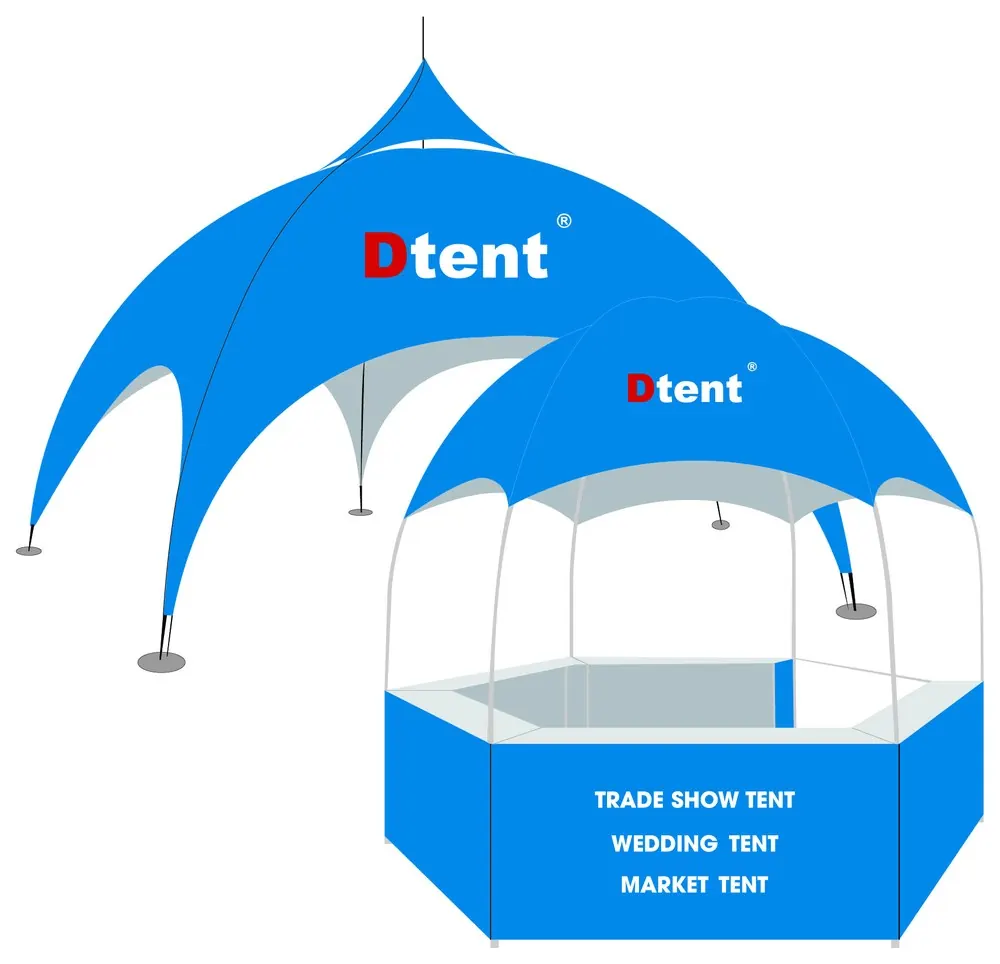
What a dome kiosk actually is
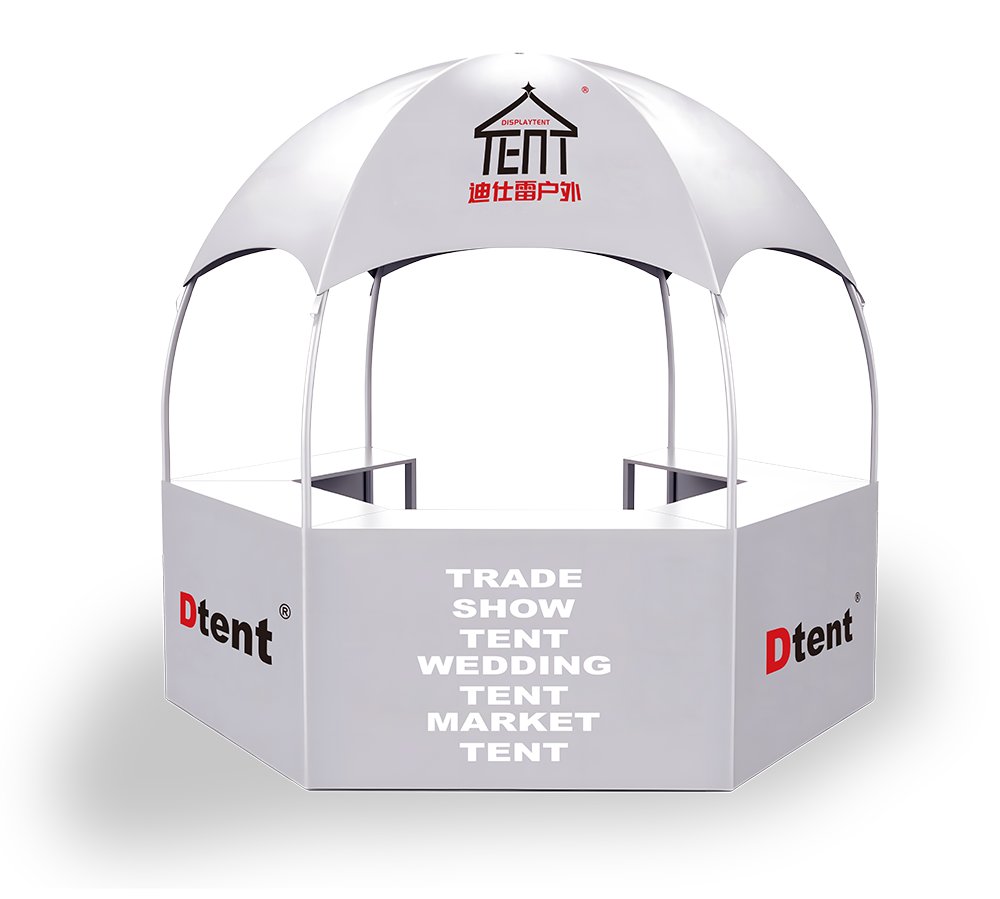
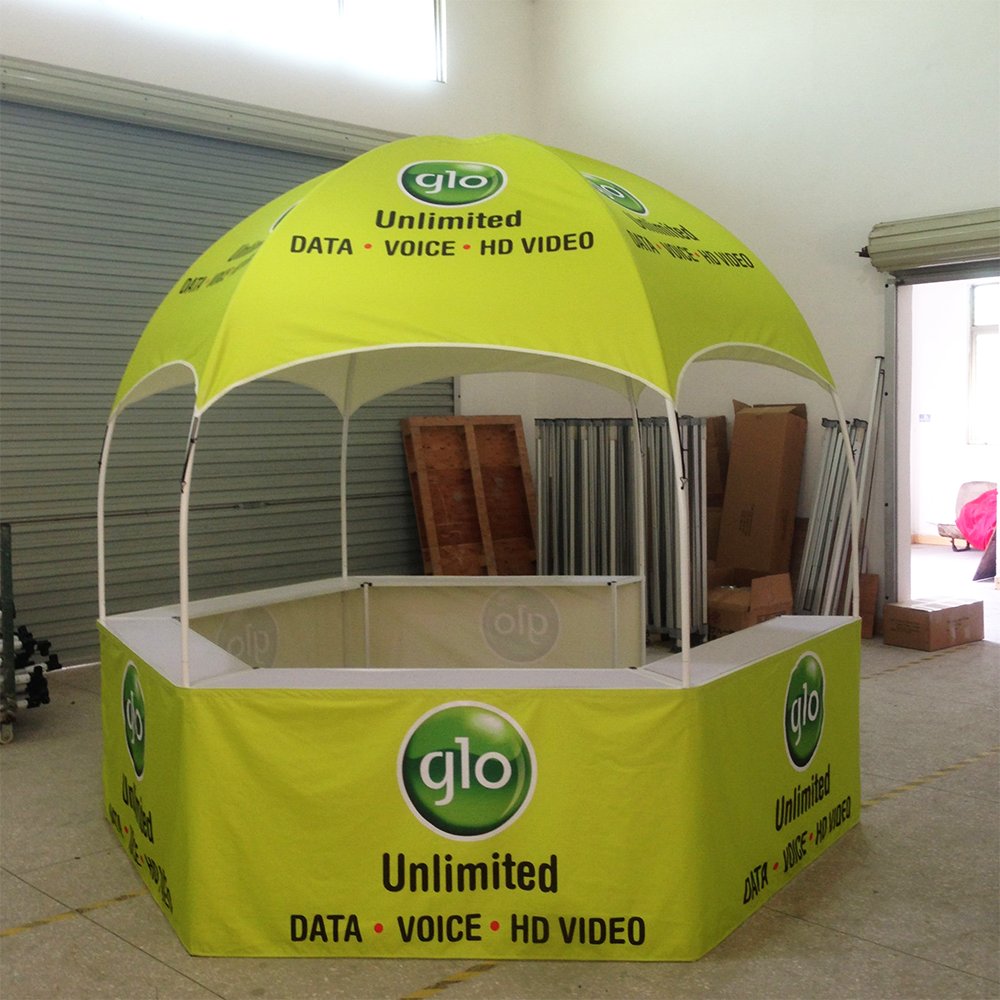
A promotional dome is a center-pole structure with a round footprint — hexagonal or octagonal in plan, with a fabric roof tensioned down to a valance band and, usually, removable walls. That geometry is the whole product. Because the load runs from the peak down through a ring of evenly spaced legs, there is no long unsupported span and no flat panel catching wind broadside. It stands on open ground, on a beach, in a car park, on grass that a square frame would turn into a kite.
We build two families. The dome runs 3m, 4m, 5m and 6m in diameter, with walls in full or half heights. The kiosk booth is the square-footprint sibling — 3x3m or 3x4.5m — with an optional counter built into one side, which is what most sampling teams actually want: a horizontal surface at standing height that separates staff from public and holds the trays and card terminal.
Size the queue, not the floor plan
The mistake we see most often is sizing by headcount — "we have four promoters, so we need a 5m". Staff count tells you almost nothing. What constrains an activation is the queue, and a queue is a length, not an area. Two people at a counter occupy about 1.2 metres of frontage; six people waiting behind them occupy another four metres, and those four metres have to go somewhere that is not the public footpath.
So the first question is not how big the tent is, but where the line stands. Three answers, three sizes:
- Queue outside. The tent only holds staff and stock, so 3m is enough even on a busy site — provided the venue lets you manage a line on the approach.
- Queue inside, single lane. You need depth behind the counter, which pushes you to 4m — where most city-centre and mall work lands.
- Two lanes or a holding area. 5m and up. Anything smaller and the lines merge and the team serves whoever shouts loudest.
3m: the smallest footprint that still works
A 3m dome gives roughly 5 square metres of usable floor once you subtract the wall angle and the center pole. Put a 1.2m counter across the front and you have a working zone about 1.8m deep behind it — enough for two people, a stack of sample trays and a cooler bag, and not much else. It is tight, and it works, because a sampling station is a production line rather than a lounge.
Where 3m wins is placement. It fits a 3.5m pavement, drops into a forecourt without a permit conversation, and two people build it in 10-15 minutes with no tools — which matters when a crew sets up six sites in a day. For high-frequency, low-dwell programs (hand out, twenty-second pitch, move on), anything larger is rent you did not need to pay.
4m, 5m and 6m: what each size buys you
At 4m usable floor goes to about 9 square metres, which is where a second counter becomes possible and the layout stops being a corridor. Our most-shipped 4m layout: counter on the front face, a low shelf unit on the back wall for stock, and a 2m gap at one end that serves as both entrance and exit. Staff work in an L, one serving, one restocking. This is the sweet spot for beverage, cosmetics and food sampling where the interaction runs 60-90 seconds.
5m (about 14 square metres) is where agencies add program to the booth: a demo table, a photo backdrop, a bench for older participants, a bin out of the customer's eyeline. It is also the smallest size that keeps a queue of eight to ten people fully inside — what you need at a festival where the surrounding ground is congested. 6m (about 20 square metres) becomes a pavilion: a demo floor, a covered test-drive queue, VIP check-in, a kids' zone. Above 6m we run an engineering check rather than quoting off a list, because wind load starts to depend on the site.
One honest note: bigger is not automatically more impressive. A 6m dome with two staff and one tray reads as empty; a 3m dome with a queue out the door reads as a brand people want.
| 3m dome | ~5 m² usable · 1 counter · 2 staff · queue outside · 10-15 min build |
| 4m dome | ~9 m² usable · 2 counters · 2-3 staff · single internal queue · 15-20 min build |
| 5m dome | ~14 m² usable · 2 counters + demo table · 3-4 staff · internal holding area |
| 6m dome | ~20 m² usable · pavilion use: demo floor, VIP, kids zone · engineering review above 6m |
| 3x3m / 3x4.5m kiosk | Square footprint, built-in counter · best where the site is a rectangle, not a circle |
Counter placement decides the layout
In a round tent the counter is a straight line cutting a curved space, and where you put it changes everything:
- Across the full front face. Maximum service frontage, no way in or out. Correct for a queue-outside site where the tent is a serving hatch.
- Front face with a 2m gap at one end. Entrance and exit in one opening. The default for 4m and 5m — staff can step out and a participant with a pushchair can get in.
- Angled at 30-45 degrees. The counter reads as a diagonal from the approach path, so the booth looks open rather than shuttered, and the queue does not form straight across a walkway. Worth the extra layout minute.
Height matters as much as position: 100-110cm works for a hand-off, 110-115cm invites people to stay and talk. Either way, keep the counter front printed — it is the one surface a participant stares at for a full minute.
Throughput math: how many samples an hour
For clients asking whether a tent is "big enough for 2,000 samples in a day", here is the arithmetic. Assume a 60-90 second interaction per person — realistic once you include greeting, product and goodbye. That yields 40-50 people per counter per hour at a sustainable pace, meaning a shift pace with breaks, not a sprint.
Two counters at 45 an hour each, across six productive hours in an eight-hour day (setup, lunch rotation, quiet spells), lands at roughly 540 interactions. To reach 2,000 you need four counters all day, or two counters across three days. The tent that fits four counters with any queue capacity is a 5m or 6m — that number should drive the order, and it comes from the sampling target rather than the mood board.
Two things reliably break this math in the field. Single-file service with one card terminal — the terminal becomes the bottleneck, so bring two. And no designated queue line: once waiting people drift into the serving zone, throughput drops by about a third.
Dome or pop up canopy: which to book
We make both, so this is a site argument rather than a sales one. The square pop up canopy has four straight walls — exactly what you want when you need to shelve stock, hang a back-wall graphic, or push three units into a row at a trade show. It also packs into a shorter bag and stacks better in a van.
The dome wins on three specific grounds. Wind: a round plan sheds gust load from every direction instead of presenting a flat sail. Visibility: from 30 metres a branded dome reads as a shape, a landmark, while a square canopy reads as a rectangle among rectangles. Site fit: on a lawn, a beach, a roundabout island or a plaza corner, the curved footprint lands more gracefully and needs less tarmac.
| Choose a dome when | Open ground, coastal or gusty sites, visibility at distance, festivals and roadshows, a photo-friendly silhouette |
| Choose a canopy when | Rectangular street and mall bays, shelving and back walls, multi-unit rows, tight van packing |
| Buy both when | A national tour hits mixed sites — one print profile, one proofing round, and the crew books per location |
Still weighing square sizes against each other? Our 10x10 vs 10x15 comparison covers the usable-space math for that family.
Wind: why the round footprint behaves better
A temporary structure fails in wind for one of two reasons: it slides, or it lifts. Domes resist both slightly better than square tents of the same footprint, because the curved roof and the even leg ring distribute load instead of concentrating it on one windward panel. That does not make them storm-proof: any lightweight branded structure is a fair-weather product.
What we do insist on is anchoring as part of the setup rather than an afterthought. On grass and soil, stakes through the base loops at every leg. On pavement, tile or indoor floors, weight bags on the base plates — enough that the structure cannot walk. Angle any open side away from the prevailing wind, and in sustained strong wind, take it down. The same discipline applies to canopies; we wrote it up in how to keep a canopy from blowing away, and every principle there transfers.
Fabric and print coverage for a tour
We offer two fabrics, and the choice is a calculation of how many times the tent will be packed and unpacked. 210T polyester, PU coated, is the budget option: light, prints beautifully, adequate for a launch weekend — but it creases if stuffed damp into a bag and left in a van for a month. 420D Oxford is the tour fabric: heavier yarn, better abrasion resistance and better crease recovery, so it still hangs flat after two hundred folds. Multi-city programs and rental fleets should pay for it; both grades carry a one-year warranty on frame and fabric.
Printing is full-color dye sublimation on roof, walls and valance — edge to edge, no white seams, no vinyl patches lifting at a corner. Which is why a dome is worth printing on all sides: at a festival the approach direction is unpredictable, and a tent that reads from one side only looks unbranded to two-thirds of the crowd. Three rules from the proofing desk: put the primary logo on the valance at eye level, the only print surface visible when the tent is full; reserve the roof for a single large mark, because detail is lost on the curve and nobody sees it from above; and use walls for a message rather than a logo repeat, because a wall is where someone stands and reads while waiting. If you are deciding between processes for a mixed order, our comparison of screen printing, sublimation and heat transfer explains which fits which artwork.
What an activation order actually contains
A dome on its own rarely covers a sampling program, and the reason to buy the set from one factory is colour match — the brand red on the dome, the flag and the table cover comes off the same sublimation line with the same ink profile.
| Structure layer | 1-6 dome kiosks, sized per site, with counters where the queue is managed inside |
| Wayfinding layer | Beach flags or A-frames 20-50m out, so the queue forms in the right place |
| Table layer | Printed table covers on any registration, tasting or sign-up table beside the dome |
| Anchor layer | Stake kits for grass, weight bags for hard standing — cheapest line item, and the one that prevents the incident report |
For a full booth rather than a single sampling point, the canopy tent packages bundle these layers at a better price than buying singly, and the layout logic in our booth kit breakdown applies to dome builds too.
Timeline: book eight weeks before the first city
Production is not the constraint. A printed dome runs 7-12 working days after artwork approval; a mixed order of domes, canopies and flags runs 12-18 days. MOQ is one piece, so a pilot unit before a national rollout costs a production slot and nothing more.
Everything around production is: artwork rounds, a physical pre-production sample if the brand requires one, and sea freight if you ship rather than air-freight. Working backwards from launch day, a comfortable order point is six weeks for air and eight to ten for sea. The full method, including the Chinese holiday windows that close the factory, is in our lead time guide.
Next step
Send the campaign brief rather than a product code: how many sites, expected samples per site per day, whether the queue stands inside or outside, and whether the ground is grass, pavement or indoor floor. We reply with a recommended diameter per site, a counter layout sketch, and a costed list covering structure, printing, anchoring and freight — plus a free 3D mock-up on the actual shape. Sizes and full specifications are on the dome tent product page.