Table Cover Sizing: 4ft vs 6ft vs 8ft Tables, Drop Length and Open-Back vs Full-Back
Table covers are the cheapest item in a booth kit and the one that appears in the most photographs. Yet sizing is where almost every disappointing order goes wrong — and it is never the print's fault. This guide works through the numbers we use on the factory floor: what each standard table actually measures, how many square metres of printed fabric you get for your money, where the drop should end, and when a full back is worth the extra fabric.
Updated 23 November 2026 · Reading time about 8 minutes · By the Dtent table cover line
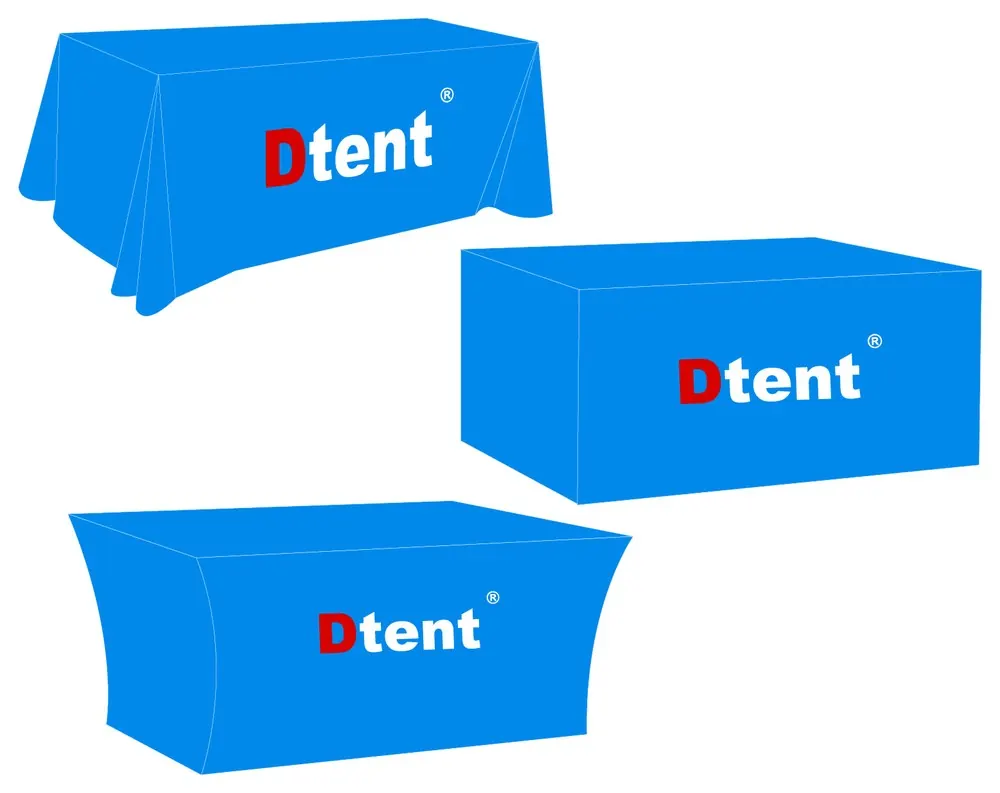
Start with the table, not the artwork
Almost every sizing problem we see starts the same way: the buyer sends artwork, then buys a table, then discovers the two do not agree. The right order is the opposite. A table cover is a garment, and a garment cannot be cut without measurements. Three numbers decide everything — length, width, height — and every other decision in this article follows from them.
The good news is that most event tables are one of three standard sizes, and if yours is not, we cut to your dimensions at no extra cost. What we cannot fix later is a cover ordered for the wrong table, because by the time it arrives the show is usually two weeks out.
The three standard tables, by the numbers
These are the sizes we cut to by default. If you are quoting a client or writing a purchase order, these are the numbers to use.
| 4ft (122 cm) | 122 × 61 × 74 cm (48 × 24 × 29 in) · tabletop 0.74 m² · front panel 0.90 m² · one seat behind, best for sampling and product demos |
| 6ft (183 cm) | 183 × 76 × 74 cm (72 × 30 × 29 in) · tabletop 1.39 m² · front panel 1.35 m² · the trade show default, two seats behind |
| 8ft (244 cm) | 244 × 76 × 74 cm (96 × 30 × 29 in) · tabletop 1.85 m² · front panel 1.81 m² · literature, registration and long backwalls, needs 2.5 m of clear wall |
One number deserves special attention: the 74 cm (29 in) height. That is the standard folding table, and it is what "floor length" means in our spec sheet. Counter-height tables at 91 cm (36 in) and 107 cm (42 in) are increasingly common at trade shows because they put staff at eye level with visitors, and a cover for one of those is a completely different cut — same length and width, 17 to 33 cm more fabric per panel. Tell us the height and it is a five-minute change on the cutting table. Assume it and you get a cover that stops 30 cm short of the floor.
How much printed area you actually get
Buyers often assume a 6ft cover is "a 6ft piece of fabric". It is not. A 4-sided, floor-length cover for a 6ft table consumes about 5.2 m² of 180–220 g polyester: the top, two long panels and two end panels. The 4ft takes roughly 3.4 m² and the 8ft about 6.6 m². At that fabric weight each 6ft cover weighs close to a kilogram, which is why a set of twelve is a checked bag rather than a carry-on.
Now the part that matters commercially: not all of that area is ever seen. The tabletop is covered by product, and the back panel faces your staff. The area that does the selling is the front panel plus the two ends — about 1.35 m² on a 6ft, 1.81 m² on an 8ft, 0.90 m² on a 4ft. That is your real advertising surface, and it is the number to think about when you decide how large the logo should be.
A working rule from the proofing desk: keep the logo between 25% and 35% of the front panel width. A 6ft panel is 183 cm wide, so a logo 46 to 64 cm wide. Below roughly 15% (27 cm) the mark dissolves at normal aisle distance of three to four metres. Above 50% it looks like a banner rather than a branded table, and it leaves no room for the product name or a call to action.
Drop length: where the fabric ends changes everything
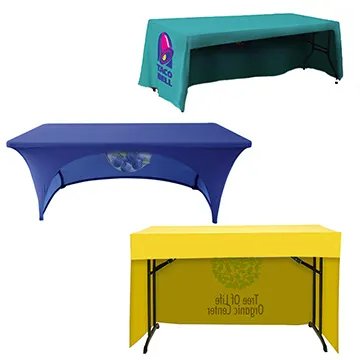
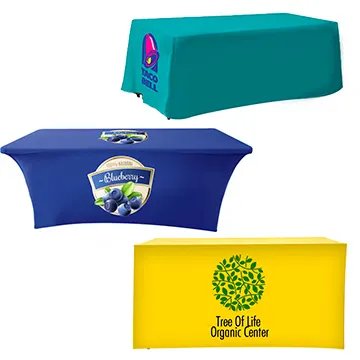
Drop length is how far the cover hangs below the tabletop. Three options cover the field, and each says something different about the stand.
Full drop to the floor is our default and the right answer for most shows. It turns an inexpensive folding table into a solid counter, hides the legs, the spare boxes and the tangle of cables, and creates one continuous printed surface from tabletop to carpet. If a visitor can see under your table, they can see your logistics — and that is never the impression you want.
A mid drop of 30 to 45 cm leaves the legs visible. It can look deliberate on a well-finished wooden table in a showroom or a hotel meeting room, but on a standard folding table with a pressed-steel leg it reads as a cover that did not fit. We cut mid drops on request; we rarely recommend them for trade shows.
Different table heights are the third case, and the one that catches people out. On a 42 in counter the same "6ft cover" needs roughly 33 cm more fabric per hanging panel. Multiply that across a set of eight and the difference is a whole extra cover's worth of fabric — worth confirming on the drawing rather than discovering at the venue.
Fitted, throw or stretch spandex?
The three styles solve three different problems. None is universally better, and the choice usually comes down to how often the table moves.
| Fitted | Tailored to the table, all four sides sewn with shaped corners. Cleanest, most formal look; hides the table fully. Best for permanent displays, reception desks and anything photographed close up. |
| Throw | Drapes three sides with an open back, no corner shaping. Fastest to fit, easiest access to stock underneath, and the most forgiving when several people set up in a hurry. |
| Stretch spandex | Four-way stretch that hugs the table like a second skin. Zero wrinkles, sets up in under a minute, and survives being folded into a ball. The choice for touring teams and rental fleets. |
For polyester covers we print by dye-sublimation, so the colour sits inside the fibre and a wash does not touch it. The wrinkle-resistant finish is what lets a folded cover come out of a case after a flight and still look presentable on the stand — which matters more than most buyers expect, because a creased cover photographs as a cheap cover no matter how good the artwork was. If you want the print method comparison in full, our screen printing vs sublimation vs heat transfer guide covers setup costs and durability.
Open back or full back?
This is the single decision with the biggest effect on both cost and daily usability, and it is decided by geography rather than by taste.
Choose open back (3-sided) when the table sits against a wall, a shell scheme panel or the back of a canopy, and staff work from behind it. There is no audience on the rear side, so the fourth panel is pure waste — and worse, it blocks the fastest route to your stock. Every time someone has to walk around the table to reach a box, you lose a minute and a customer's attention.
Choose full back (4-sided) when the rear of the table is visible: an island booth, a table standing in an open aisle, a registration desk in a hotel lobby, or a double-sided stand where visitors approach from two directions. A full back also hides what is underneath from every angle, which is worth real money at consumer shows where visitors walk the full perimeter.
The mistake we see most often is ordering full back by default "to be safe". On a back-wall table it costs fabric, slows setup and makes the stand harder to work. If you are unsure, describe the layout and we will say which one we would cut.
Print coverage: what actually drives the price
Covers from our line run from $15 to $52 per piece, FOB Dongguan, and the spread is explained almost entirely by three things: table size, style, and how much of the cover carries print.
- Logo only, front panel. The lowest-cost route and still the most common for teams ordering 20 or 50 units for a dealer network. One clean mark on a solid ground.
- Front plus both ends. The mid tier. Ends are seen by anyone walking the aisle, so this is what most trade show buyers actually need.
- All-over print including the tabletop. Top of the range. Right for brands with a pattern, a full-bleed campaign look, or a colour that has to run to the edge of every surface.
Fabric weight matters too. We use 180–220 g smooth polyester for sublimation, and the heavier end of that band drapes with fewer visible creases and holds its shape over a three-day show. Pantone matching is included at no charge — send the reference and we match the brand colour rather than approximating it. Volume pricing starts at 10 pieces, and the minimum order is one piece, because a single cover for a pilot show is a perfectly sensible way to test a design before committing a season's budget.
Booth layout math for 3 × 3 m stands
Sizing a cover is half the job. The other half is deciding how many tables fit — and the answer is often fewer than people assume.
A standard shell scheme is 3 × 3 m (10 × 10 ft). One 6ft table across the back occupies 76 cm of depth and leaves 2.29 m of open floor, which is comfortable for two staff and three visitors. Add a second 6ft table in an L and the usable open area drops to roughly 1.2 × 1.2 m — still workable, but only if nothing else is on the floor. Add a third table and you have built a corridor, not a stand.
The layouts that consistently work: an 8ft table across the back for literature and registration when you have 2.5 m of clear wall; paired 4ft tables for product demonstration because visitors stand at them rather than behind them; and a single 6ft counter-height table at the aisle corner to catch passing traffic. Match the table to the job and the cover follows.
Quantity math for a show season
Most first orders are one cover per table. That number is almost always too low, for a reason that has nothing to do with wear: laundry and logistics.
The workable formula is tables × 1.5, rounded up, plus one spare. A team running three tables gets five covers. That allows one set on the stand, one in the wash or in transit, and a spare for the show where a courier loses a case. For a six-show season with three tables, twelve covers would be over-ordering and three would guarantee a last-minute panic.
There is a second-order benefit: ordering the full set at once means every cover comes off the same dye lot with the same Pantone profile. Covers reordered six months later will match closely, but "closely" is not "identically" under show lighting, and a mismatched pair of table covers side by side is noticeable from the aisle.
Washing, wrinkles and multi-day shows
Sublimated polyester is close to indestructible in normal use. Machine wash cold, hang dry, low iron on the reverse if the drape needs sharpening. No bleach, no high dryer heat, no dry cleaning. The print will not crack, peel or fade, because the colour is in the fibre rather than sitting on top of it — the same reason a cover can come back from twenty shows looking like it came back from two.
Wrinkles are a storage problem, not a fabric problem. Folded flat in a case for a week, a cover creases along the folds; hung for a day, most of it relaxes. For long-term storage, roll rather than fold, and keep the roll loose. Between shows on a multi-day run, spot clean with a damp cloth rather than washing — a full wash cycle mid-tour rarely gets a chance to dry properly.
Lead time and what to send with your order
Printed covers run 5 to 8 working days after you approve the proof on the line, and 2 to 3 days for a reorder of a design already on file. Plan 7 to 12 working days from order to goods ready once proofing and packing are included, and 12 to 18 days for larger mixed orders that combine covers with canopies, flags or tables in one shipment. The planning method behind those numbers — including the holiday windows that surprise first-time importers — is in our custom tent lead time guide.
To get an accurate quote in one reply, send five things: table length, width and height in centimetres; fitted, throw or stretch; open or full back; vector artwork with Pantone references; and the quantity, including any spare you want to hold. With those five, we return a quote and a mock-up within one business day, and a pre-production sample is photographed for approval before mass production. If you are still assembling the rest of the stand, the canopy tent package route puts table covers, canopy and flags on one purchase order and one shipment, and our booth kit breakdown shows what a complete configuration contains.
Next step
Send your table dimensions and the layout of the stand — a photo of the venue floor plan is enough. We will reply with the right cut for each table, a recommendation on open versus full back per position, and a written production schedule against your first show date. Styles, fabrics and the full specification live on the table covers product page; if you are still deciding between table types for the rest of the stand, start with the pop up canopy range.