Beach Umbrella vs Garden Parasol: Which Branded Umbrella Fits Your Site?
Every week we get inquiries that just say "custom umbrella with our logo" — and they turn out to mean three completely different products. A surf school wants a sand-screw beach umbrella it can carry down the beach. A resort wants a 3.0m crank parasol that stands on the pool deck all season. A café wants something in between. Buying the wrong type is the most common and most expensive mistake in this category, so this guide separates the three, works through sizing, anchoring, fabric and printing, and finishes with the quantity math we use with beach clubs, hotels and brand teams.
Updated 25 November 2026 · Reading time about 7 minutes · By the Dtent outdoor team
One word, three very different products
Start by naming what you actually need, because the three types share a printing press but almost nothing else:
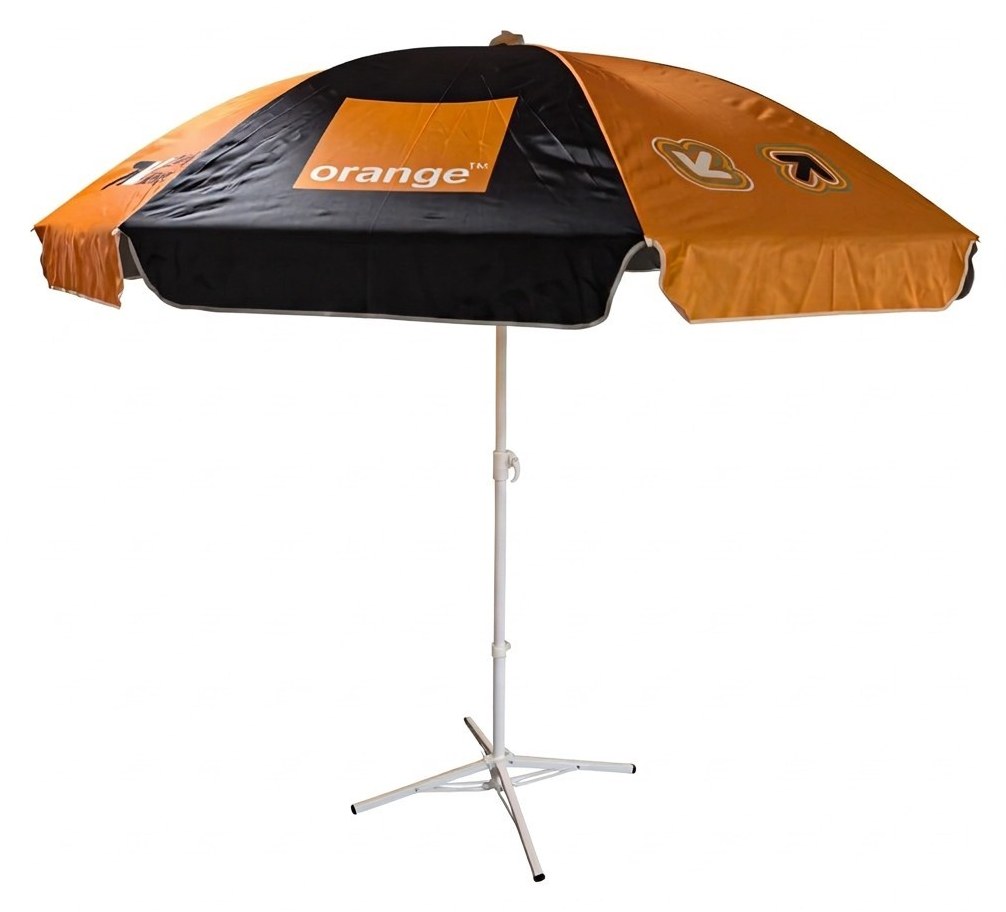
- Beach umbrella. Pointed or sand-screw pole pushed straight into sand or grass. Light frame, tilt to follow the sun, canopy from 1.6m to 2.4m arc. It travels — that is the point. Built for beach clubs, surf schools, lifeguards and brand giveaway campaigns.
- Garden parasol. A heavier pole (wood, aluminum or steel) with crank and tilt, standing in a base — cross, granite slab or water-filled. Canopy 1.8m to 3.0m round or square, single or double tier. It stays put for a season. Built for hotels, cafés, restaurants and garden centres.
- Patio/crank umbrella. Functionally a garden parasol with an aluminum pole and a modern finish — same printing options, same bases. Most "patio umbrella" inquiries are this line, and we treat the two as one family in quoting.
If your site is sand, buy beach umbrellas. If your site is deck, tile or lawn with furniture underneath, buy garden parasols. Mixed sites — a beach club with a terrace restaurant, for example — buy both, and order them from one factory so the brand colors match across the property.
Sizing: what each diameter actually covers
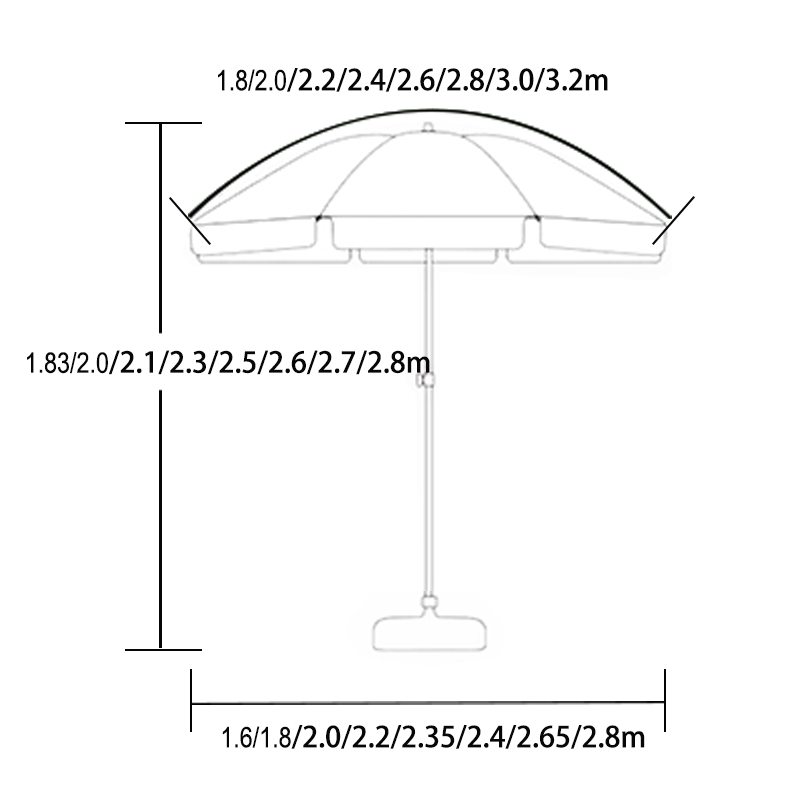
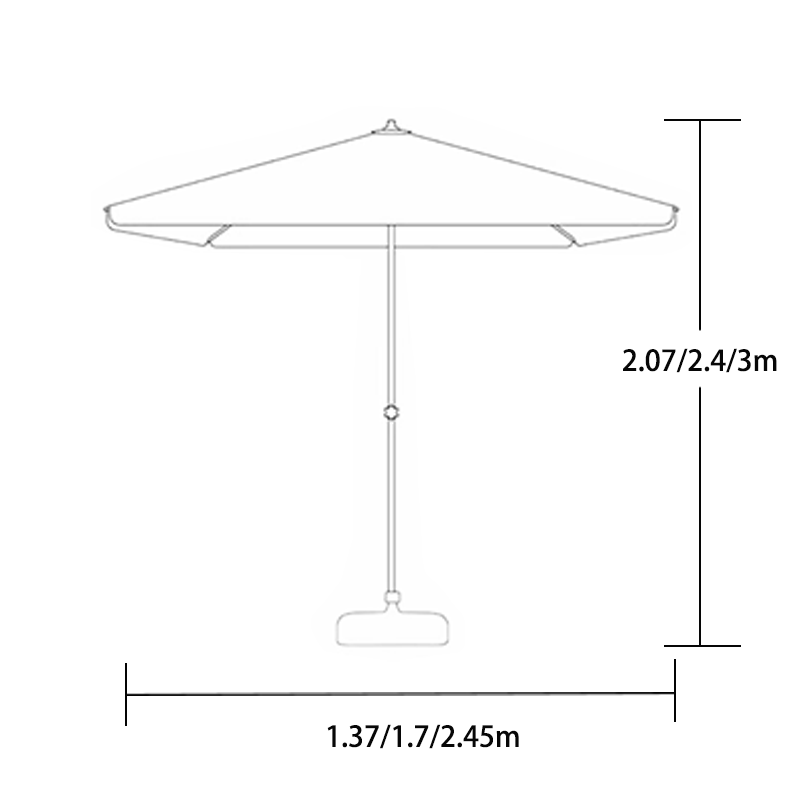
Umbrella sizes are quoted as arc — the distance along the curved canopy edge from one rib tip to the other — not as flat diameter, which is why a "2.4m" umbrella does not shade a 2.4m square. Work from coverage instead:
| 1.6m arc | One person or a single lounger. Surf schools and budget giveaway campaigns. |
| 1.8m arc | Two people, one couple on sand. The beach-club standard. |
| 2.0m arc | Two to three people, or a café table with two chairs. |
| 2.2–2.4m arc | A family group on sand, or a small table plus chairs. The top of the beach range. |
| 2.5–3.0m parasol | A 4-seat table, or two loungers, or a poolside corner. Square 3.0m covers a rectangular café layout better than round. |
Two practical rules from real orders. First, smaller umbrellas in greater numbers beat one giant canopy almost everywhere: they follow the sun individually, they survive gusts better, and they photograph as a branded row — which is exactly the look beach clubs sell. Second, the double-tier parasol (a second, smaller canopy above the main one) adds ventilation and a second printable surface, which matters on exposed terraces.
UPF50+ fabric: what the coatings really do
Every canopy we print runs on 190T or 210T pongee with UPF50+ rating — the fabric itself blocks 98%+ of UV. But the coating underneath is what buyers should actually ask about, because it changes both protection and how the print looks:
- Silver coating — the workhorse. Good UV block, darkened underside, slightly cooler under the canopy. The default for beach umbrellas.
- Black-UV coating — the highest UV block of the three and a darker shade under the canopy. The resort line's favorite, because guests notice the cooler shade.
- Plain PU coating — the lightest option. Fine for shorter-season giveaway campaigns where budget leads.
One print-side note that surprises marketing teams: the coating goes on the underside, so the printed top surface behaves like normal dyed fabric — colors stay bright, and the canopy fades at roughly the same slow rate as any sublimated outdoor textile.
Frames: fiberglass ribs and pole materials
The rib material decides how an umbrella dies. Steel ribs bend and stay bent; fiberglass ribs flex in a gust and spring back. Our beach umbrellas run 4.5–5mm fiberglass ribs as standard, with steel options only for tight-budget lines. Over a season, the fiberglass difference is the difference between replacing a handful of units and replacing none.
Poles split by product: beach umbrellas use a two-piece 22/25mm powder-coated steel pole with a sand screw or pointed tip; garden parasols step up to wooden, aluminum or steel poles with crank-and-tilt. Wooden poles read "premium" and suit garden centres and Mediterranean-style resorts; aluminum suits coastal properties, because it does not corrode in salt air. Tell us your site's distance from the sea and we will steer the material — it is a five-second question that saves an annual pole replacement.
Anchoring by surface: sand, lawn, deck and tile
An umbrella is only as good as what holds it up, and each surface has a right answer:
| Sand | Sand-screw pole tip — twist it 30–40cm into the sand. No separate base to carry; the ground is the base. This is the single biggest reason beach umbrellas and garden parasols are not interchangeable. |
| Grass / lawn | Pointed pole tip pushes in for beach umbrellas; event parasols use a cross base with a weight on top. |
| Deck / tile / concrete | Base only. Cross base plus water-filled bags is the budget route; a granite slab base is the resort route — heavier, flatter, and it looks like furniture rather than equipment. |
| Wind-exposed sites | Combine base weight with the vented double-canopy build, and close umbrellas when the site is unattended. |
The anchoring logic is the same one we teach canopy buyers — weight at the base beats hope at the top. If you are also specifying shade canopies for the same site, our canopy anchoring guide walks through the same math for larger structures.
Wind: what an umbrella can and cannot take
Set expectations honestly. A fiberglass-ribbed beach umbrella screwed into sand handles a normal beach day, including the gusty afternoon hours, because the ribs flex and the canopy sheds load. Three upgrades change the picture on exposed sites:
- Vented double canopy — a sleeve vent at the crown lets wind pass through instead of lifting the whole canopy. Our standard recommendation for beach clubs on open coast.
- Fiberglass everywhere — ribs and spreaders. One steel rib in a fiberglass set becomes the failure point.
- Base weight or depth — deeper screw on sand, heavier slab on deck. Tilt the canopy into the wind, not broadside to it.
And the honest limit: umbrellas are temporary shade, not structures. Sustained strong wind or an unattended site overnight — close them. A closed umbrella is a folded pole; an open one on a stormy night is a kite with a metal stick. Resorts that enforce this simple rule replace almost no canopy fabric; the ones that leave umbrellas up all season do.
Printing: 8 panels are your billboard
Here is where custom umbrellas quietly outperform almost every other promo in the catalog. A canopy is built from 8 panels, and every one of them is printable by dye-sublimation — with full Pantone matching at no extra cost, because sublimation prints from a digital file with no screen setup. In practice that means:
- Alternate-panel branding — logo on 4 panels, pattern or website on the other 4. Reads cleanly from every direction without overwhelming the design.
- Per-panel storytelling — one language or one product per panel for export markets and multi-market campaigns, at zero setup difference.
- Edge-to-edge color — full-bleed brand color canopies where the entire umbrella becomes the brand. Resorts love the photo result: a row of solid-brand umbrellas is the resort's social feed for the whole season.
The printing method conversation matters more on canopies and flags, where volumes justify screen setups — we compared all three methods in this guide. On umbrellas, sublimation is simply the right default, and 1-panel to 8-panel coverage scales the price with how much of the canopy you actually print.
Quantity planning for beach clubs, resorts and cafés
The quantity math we run with buyers, by site type:
| Beach club | One 1.8–2.0m umbrella per couple/family spot. A 40-spot club runs 30–40 beach umbrellas, ordered in brand colors so the row photographs as one brand. |
| Resort pool deck | One 2.5–3.0m parasol per two loungers or per table. A 20-lounger deck runs 10–12 parasols, granite bases for the tile deck. |
| Café terrace | One 2.5–3.0m square parasol per 4-seat table. Square covers a rectangular table layout better than round at the same size. |
| Surf school / rental | One 1.6–1.8m per instructor station, fiberglass ribs mandatory — rental gear takes abuse. |
| Brand giveaway | 1.6–2.0m, plain PU coating, single-panel print. The volume-discount tiers from 10 pcs start doing real work here. |
Add 10% to any fleet order for attrition — poles lost to wind, frames left by guests, the one unit that becomes the staff favorite. Ordering the spare set in the same production run costs a fraction of a later top-up order.
What buyers order together
Umbrellas rarely travel alone. The most common companion orders from the same properties:
- Table covers for the terrace and poolside F&B tables — sized to standard 4/6/8ft tables; the sizing math lives in our table cover guide.
- Beach flags at the entrance and along the promenade — feather flags pair naturally with a row of branded umbrellas.
- Pop up canopies for the beach-club bar, reception or event days, printed in the same Pantone set.
- Sandbags and bases — the unglamorous line item that keeps every umbrella and canopy standing.
One factory for all of it means one dye-sub line and one Pantone profile — the brand red on the umbrella, the flag and the table cover matches. Mixed suppliers produce three slightly different reds, and hotel guests and brand managers both notice.
Timeline: how the order runs
Send your artwork, sizes and quantities; we return a free 3D mock-up and quotation within 24 hours. After you approve, a pre-production sample of your actual canopy is photographed for final sign-off — no surprises at delivery. Production runs 7–12 working days for a single-product order; mixed large orders that combine umbrellas with canopies, flags and covers run 12–18 days. Samples can ship from 1 piece, and full custom printing starts at 50 pieces. Pricing runs $8–$60 per piece FOB Dongguan depending on size, frame grade, fabric and print coverage, with volume discounts from 10 pcs. The full planning method — including the holiday windows that catch first-time importers — is in our lead time guide.
Off-season care and storage
Umbrellas reward simple care. Close them dry — a canopy stored wet grows mildew spots that no washing removes. Rinse salt off beach-club units at season's end; salt is what actually corrodes steel poles, not rain. Store parasol canopies off the pole, rolled loosely in their polybag in a dry room, and stand poles upright or flat — not leaning against a wall where they bow over months. A fleet treated this way comes out of storage looking like the day it shipped, which is why properties that buy good umbrellas replace them for branding reasons, not structural ones.
Next step
Tell us your site — sand, lawn or deck — the number of spots you need to shade, and how many colors your brand needs. We reply with a size recommendation per spot, a free 3D mock-up of your printed canopy, and a written production schedule. Sizes, frame options and the full spec table live on the custom beach umbrella & garden parasol page.