Booth Kits by Industry: How Auto, Beauty, Tech, Food and Education Buyers Configure Their Packages
Five buyers send us the same sentence — "we need a 10x10 booth kit" — and five different booths come back. A cosmetics brand means a sampling counter you can wipe down between testers. A car dealer means a two-bay stand with a 5.5 m flag visible from the road. A tech company means a dark backdrop that throws no glare onto a monitor. This is how the industry, more than the footprint, decides what goes in the box.
Published 21 November 2026 · Reading time about 9 minutes · By the Dtent engineering team
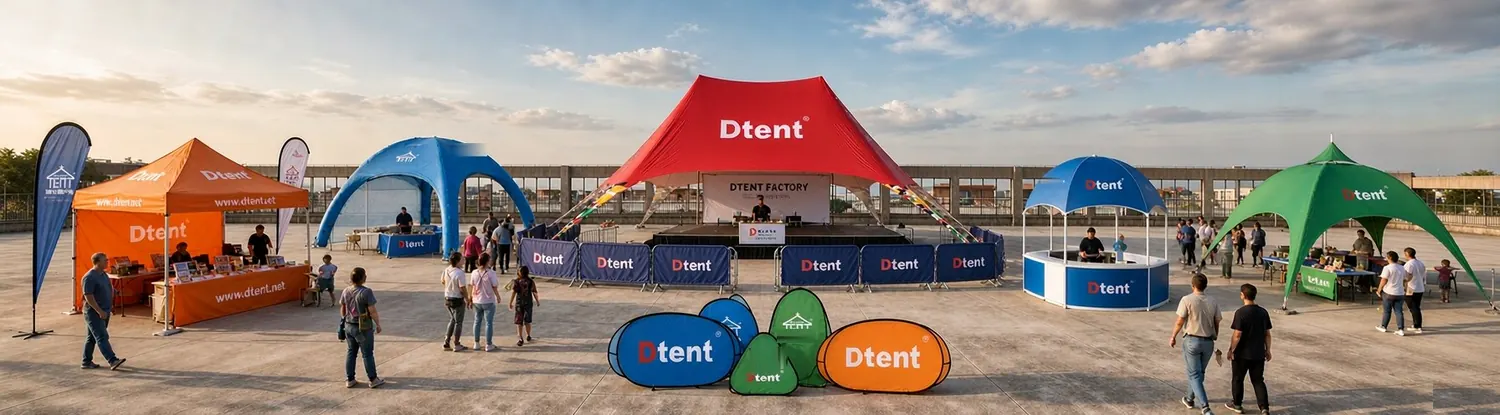
Why the industry decides the kit, not the footprint
The booth size tells you what physically fits on the floor plan. It tells you almost nothing about what the booth has to do. We quote kits from $209 to $680 per kit, and that band is not margin — it is configuration. Two 10x10 kits at opposite ends of it are doing completely different jobs.
When a buyer tells us their footprint and stops, we end up asking the same four questions anyway. Once you answer them, the kit configures itself.
The four axes every industry is really buying
Strip away the product categories and every booth request reduces to four variables. Get these right and the tier, the walls and the flags all follow.
| Sightline | How far away must someone read it? A forecourt booth is read at 40–50 m across a car park; a recruitment stand at 3 m by someone already walking towards it. This decides flag height and headline size. |
| Dwell | Do people stop, and for how long? Food sampling holds someone for 40 seconds; a tech demo holds them for six minutes. Dwell decides whether you need a counter, a table or a bench. |
| Surface | What must be wiped, hold weight or stay dry? A beauty tester tray and a hot-food counter are both "a table" — only one of them is a fabric table cover. |
| Storage | What lives behind the booth? Stock, samples, tools, staff bags. This is why backwalls exist, and why an open-back booth is a mistake in four of the five industries below. |
Everything else — colour matching, frame grade, packing — is shared across industries and covered in our item-by-item kit breakdown. The differences sit in these four rows.
Automotive: sightline first, everything else second
Dealer groups, motorsport teams and test-drive activations are the most sightline-driven buyers we have. A forecourt booth competes with a road, a showroom window and three rival flags. The job is not to explain the car — the car explains itself. The job is to be the thing a driver notices at 40 km/h and turns into.
- Footprint. 10x20 ft, or two 10x10 joined. One bay for the vehicle or seating area, one bay as an enclosed back room for brochures, giveaways and staff bags.
- Tier. Premium — the reception counter is where test-drive bookings get written.
- Hero item. A 5.5 m feather flag in the OEM brand colour with a 10x20 printed valance. The valance reads at distance; the flag gets seen first.
- Watch-out. Clearance. Check your tallest vehicle against the eave height before you approve the drawing.
The hard part in automotive is colour, not fabric. OEM guidelines specify Pantone references, sometimes with a metallic secondary that dye-sublimation renders flatter than paint. We ask for the guideline PDF at quotation and print a strike-off before the full run, because a dealer principal will compare the canopy against the paint in daylight. That review adds a few days to artwork approval and is worth every one.
Beauty and cosmetics: the counter is the product
A beauty booth sells a physical sensation. Its job is to make trying something feel clean, lit and unhurried; everything else is secondary.
- Footprint. 10x10 ft, but only if the counter sits at the front edge and the back is closed — testers and stock behind a backwall, staff in the middle.
- Tier. Standard, upgraded with a printed counter from the Premium list.
- Hero item. The fitted 6 ft table cover in 180–220 gsm polyester — the surface that gets touched, spilled on and photographed, and the cheapest thing in the box to replace.
- Watch-out. Sightline is short here (3–5 m), so brands over-correct and print a forecourt-sized headline that looks shouty up close. Wall graphics carry the story; the valance carries the logo.
Two notes from shipped orders. A half sidewall on the queue side gives enclosure without closing the booth off — most beauty brands settle on it after one show without it. And mirrors or lit tester displays come from local suppliers; we plan wall space and leave a clean panel rather than building them into a kit. Being honest about that boundary saves a month of back-and-forth.
Technology: the backdrop is doing the work
Tech exhibitors have the opposite problem. Nobody needs to spot them across a hall; they need the people who do walk over to stay for six minutes. The booth's job is to remove glare and provide a surface at the right height.
- Footprint. 10x10 for a demo stand, 10x15 with two demo stations and a meeting corner.
- Tier. Standard, with the backwall carrying the message. Premium only with a hospitality element.
- Hero item. The printed backwall in a dark, matte ground. A monitor on a dark matte wall reads cleanly; the same monitor on white or glossy disappears in hall lighting.
- Watch-out. Power and cable routing. Ask for the floor plan's power locations before you finalise the layout — moving a bench after mock-up approval costs a reprint.
We deliberately keep electronics out of the kit and build the booth around them instead: a counter with a cable pass-through, a bench-height surface at 90 cm for standing demos, and walls positioned so the brightest light in the hall is behind the visitor rather than behind the screen. Those three decisions cost almost nothing at order stage and cannot be fixed on site.
Food and beverage: washable beats beautiful
Food buyers use their booths harder than anyone. A market stall may go up five days a week for a season, get hosed down and be packed away wet. The configuration has to survive that, not just photograph well.
- Footprint. 10x10 is the workhorse; 10x15 when there is a prep zone behind the service counter.
- Tier. Starter for market traders, Standard for brand sampling programmes — both usually add a half sidewall on the weather side.
- Hero item. The fabric specification. For daily use we recommend 500D PVC-coated polyester rather than 420D Oxford with PU backing: it wipes clean, resists grease and does not soften after repeated washing.
- Watch-out. Fire rules. If there is gas, hot equipment or cooking under the canopy, ask the venue what documentation they need and tell us at quotation stage. We can supply flame-retardant fabric with test documents; retrofitting FR to a finished kit is not possible.
The other food-specific detail is the floor. Sampling stands go up on asphalt, turf and wet pavement in the same month. A printed floor mat is not glamorous, but it defines the booth's edge, keeps bags off wet ground and gives staff somewhere dry to stand for a six-hour shift. It is the item food buyers forget most and reorder most.
Education and recruitment: a conversation booth
Universities, training providers and recruiters are the most price-sensitive of the five and the most volume-driven — a careers fair means five to twenty stands, not one. Their booth has one job: make a stranger comfortable enough to sit down.
- Footprint. 10x15 with two 6 ft tables, or 10x20 for a counsellor station plus a display wall.
- Tier. Standard; Starter for a pure brochure drop, Premium almost never — a counter is wasted when the conversation happens across a table.
- Hero item. The printed backwall. Prospects read it while waiting, which is exactly the moment you want programme names, intakes and accreditation marks in front of them.
- Watch-out. Text volume. This is the only vertical where a dense backwall is correct — just keep type above 24 mm cap height so it reads from the aisle.
Recruitment stands live and die on seating. Two chairs at a 6 ft table beat a reception counter every time, and the table cover should stop short of the floor on the visitor side so nobody's knees fight the fabric. Small thing; it is the difference between a ten-minute conversation and a two-minute one.
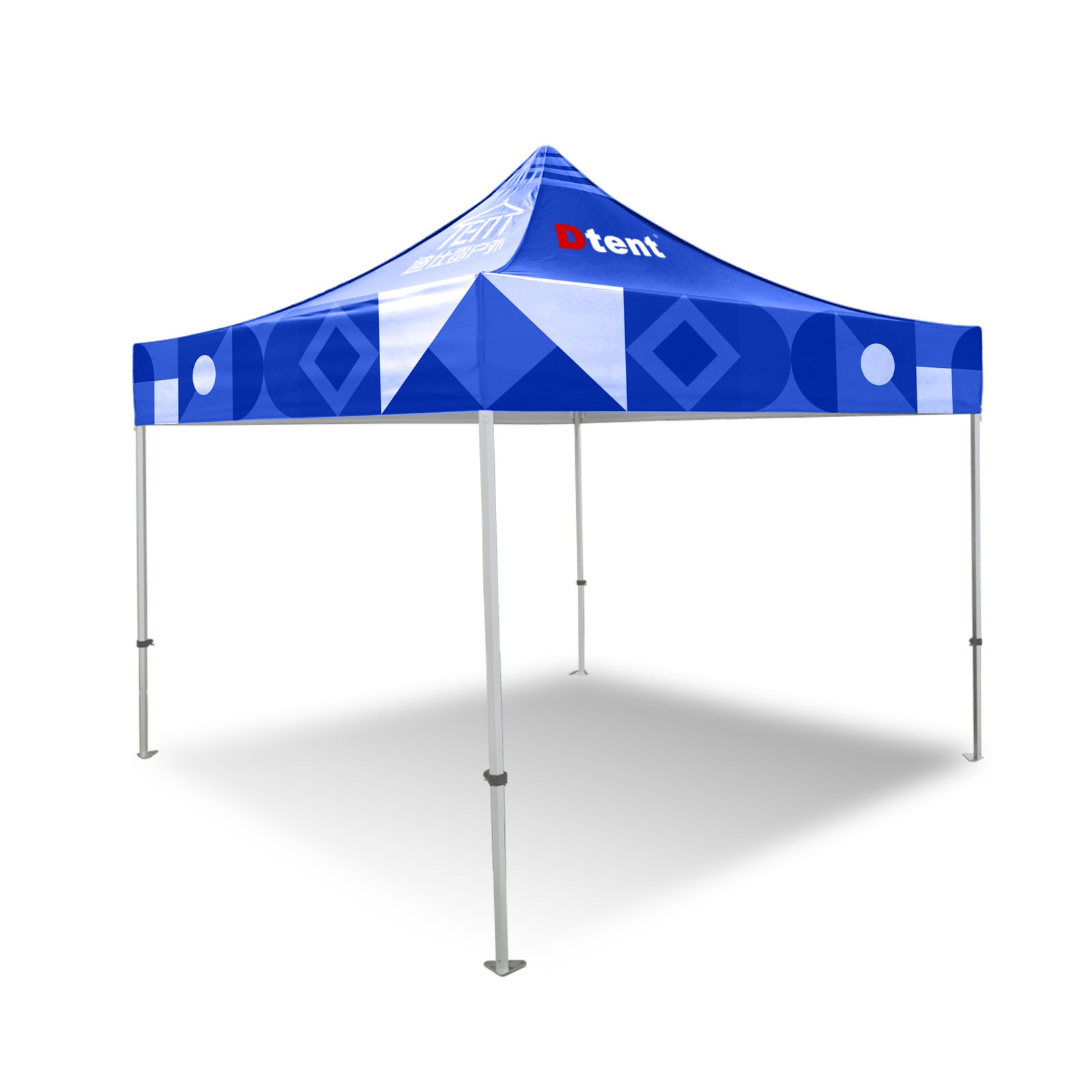
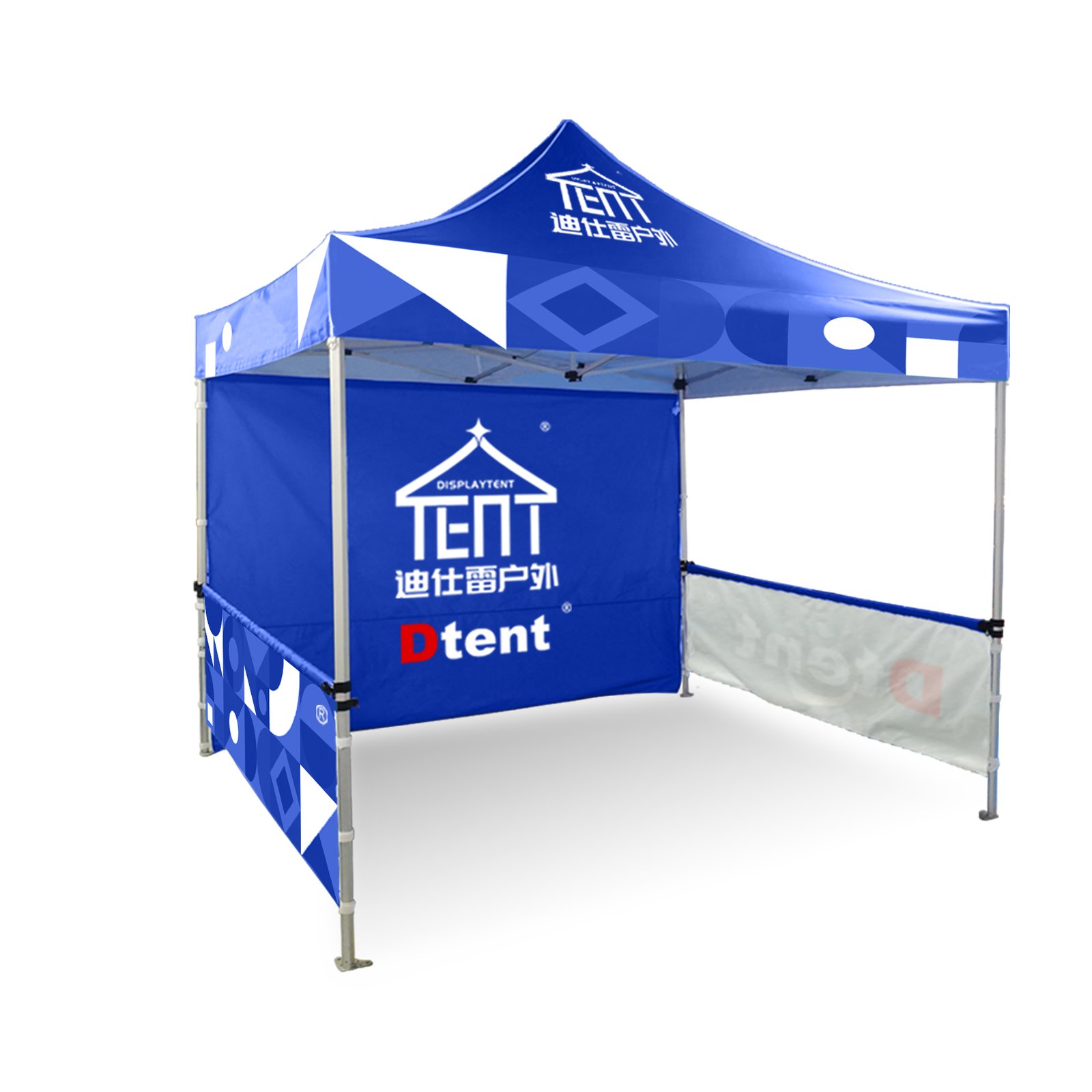
The five configurations side by side
This is the table our sales engineers work from when a buyer names an industry instead of a specification — a starting point, not a rule book.
| Industry | Typical footprint | Tier | Hero item | Biggest mistake |
|---|---|---|---|---|
| Automotive | 10x20 or 2 × 10x10 | Premium | 5.5 m flag + printed valance | Ignoring vehicle clearance |
| Beauty | 10x10 | Standard + counter | Fitted table cover | Forecourt-sized type up close |
| Technology | 10x10 / 10x15 | Standard | Dark matte backwall | No power at the demo bench |
| Food & beverage | 10x10 / 10x15 | Starter / Standard | 500D PVC-coated fabric | No floor, no FR certificate |
| Education | 10x15 / 10x20 | Standard | Copy-dense backwall | Counter instead of seating |
Price lands between $209 and $680 per kit depending on where a row sits on that table; everything above the Starter tier is a variation on the Standard.
What stays identical across all five
The configuration changes; the manufacturing discipline behind it does not. Three things stay constant, and they are why buyers consolidate five verticals into one order.
- One colour run. Canopy, flags, table cover and walls print in the same dye-sublimation pass against the same Pantone references. Five industries buying from five suppliers get five slightly different brand reds — a brand problem that is expensive to fix later.
- One carton list. Each kit ships as a labelled set — canopy bag, frame bag, flag bags, wall pack, table cover, sandbags — so a warehouse hands one stack to one crew without opening anything.
- One frame decision. Frame grade follows setup frequency, not industry. Twice a year can be 30 mm steel; twice a week needs 40 mm steel or aluminium. It is the only question a food trader and a car dealer answer the same way.
If your programme moves between cities rather than staying in one hall, the packing and case-weight side of this is a separate discipline — our roadshow kit configuration guide covers spares ratios, the 90-minute stop standard and cost per stop.
Cost per lead: where the vertical changes the number
Buyers ask which tier is "worth it". The honest answer is that the tier is worth it or not depending on how many times the kit goes up, not on how impressive it looks on the day.
Take a $680 Premium Kit used at twelve events a year: about $57 of kit per event, roughly a dollar per conversation against 60 a day. The same kit used once costs $680 per event and looks expensive; the identical box, used twelve times, is the cheapest line item in the booth budget.
That is why we push usage count before tier. Six or more outings a year and upgrading the frame and adding a counter pays back inside two seasons. One trade show only, and the Starter or Standard is the rational buy — the money is better spent on artwork. The vertical only changes how many conversations a day you can physically have: 40–60 for automotive, 20–30 demos for technology, several hundred samples for beauty and food, 60–100 for education.
Ordering calendar: 6–8 weeks, or 8–10 for Europe
Standard kits run 7–12 working days after artwork approval and deposit. Large mixed orders — five vertical variants in one purchase order, each with its own artwork set — run 12–18 days, because the proofing rounds multiply even though the production line does not. MOQ is one kit, so a single store can test a configuration without a committee decision.
Production is never the bottleneck. Artwork approval is. Automotive brand guidelines and beauty claim substantiation both add review cycles you do not control, and a five-variant order can absorb two weeks before a single panel is printed. Plan to order 6–8 weeks before a US show date and 8–10 weeks before a European one. The full planning method, including the Chinese New Year window that catches first-time importers every year, is in our lead time guide.
Next step
Tell us your industry, your footprint and the one thing your booth must achieve. We reply with a recommended configuration, the accessories that earn their place, a free mock-up in your brand colours and a production schedule against your show date. Tiers and contents are listed on the canopy tent packages page; if you are still deciding between a 10x10 and a 10x15, this comparison settles it in five minutes.